Showing posts with label Guattari. Show all posts
Showing posts with label Guattari. Show all posts
Monday, December 22, 2008
Mladen Dolar on Psychoanalysis and Politics
In a recent lecture, Mladen Dolar offers an instructive meditation on the (non-)relation of psychoanalysis and politics. He claims that psychoanalysis institutes a social bond on the basis of the death drive, as that negativity inscribed in every positive social relation, ultimately the potential unbinding or untying of these relations, their precariousness. In this way, psychoanalysis prepares the site of politics, which amounts to the rejection or suspension of substantial, conventional sociality, the interruption of the positive order. Yet in doing so, psychoanalysis cannot go any further than a 'preparation' - it cannot engage in a political struggle, cannot prescribe political commitments, or in other words, it can promote the interruption of these bonds, but cannot offer anything positive to replace them.
By way of contrast, if psychoanalysis falls short of political intervention, by preparing the political site, only to leave the intervention up to an extra-psychoanalytic moment of decision, then politics (in the Badiouian sense) goes too far, covering over or erasing the moment of negativity of the political site through the institution of a new positive social order, qua evental fidelity. Dolar seems to offer a kind of solution to that great problematic core of Badiou's doctrine of the Event, as noted by, among others, Adrian Johnston (PDF) and Levi Bryant (PDF) - the question of a pre-evental preparation, or of the intra-situational conditions of an Event. Badiou seems stuck in fundamental ambiguity between the claim that Events are entirely incalculable and unaccountable in terms of the situation in which they arise, and the claim that Events don't 'come from nowhere', that they are grounded in and conditioned by the spectral traces of effaced events, inertly circulating within existing situations (what he calls 'evental recurrence').
Dolar seems to offer up psychoanalysis as precisely a praxis of preparation, of bringing about the Evental site qua condition. In this way, we can easily understand psychoanalytic symptoms as symptoms of failed, effaced, or missed Events (this is how, for example, Eric Santner understands symptoms); and the Lacanian subject positions can be read as 'compromise formations' resulting from the failure of Evental fidelity, the products of failed subjectivation. The twist here is that, for psychoanalysis, there can only be 'failed subjectivations', the subject as such is a failure of the symbolic mandate, it is a way of coping with the imposibility of fully 'becoming what one is'. So while Dolar seems to propose, albeit problematically, that psychoanalysis can fill the missing role in Badiou's theory of a 'pre-evental discipline of time', as Johnston puts it, there is nonetheless a fundamental incongruity. If psychoanalysis 'merely' prepared the site for a proper Evental/political subjectivation, then it would seemingly be complicit in betraying its own definitive insight - that subjectivation is inherently 'improper', and that the subject is ultimately the result of a failure; the subject is intrinsically symptomatic, and so the failure cannot be 'undone' without the subject also coming undone.
Dolar already offers the key to this deadlock, when he describes both psychoanalysis and Badiouian politics as circling around the political site of pure unbinding, the former falling short of it, the latter going too far beyond it. Can we envision a political praxis that seeks, like psychoanalysis, to open up this site, but rather than instrumentalizing this site as the means to some specific political end, makes the opening and holding-open of this site its explicit goal? This is something Zizek has been hinting at for quite some time, and the he, in his lecture following Dolar's, continues to foreshadow.
For anyone familiar with this blog, my answer should come as no surprise: the name of such a praxis is schizoanalysis. Dolar, in his lecture, does briefly touch upon Deleuze and Guattari, if only to implicitly suggest that Guattari's politicization of analytic practice, in subordinating the political site of 'unbinding' to explicit political goals, thereby misses the crucial dimension of analysis in the same way as Badiou. To put it in schizoanalytic terms, Dolar criticizes schizoanalysis as subordinating analytic deterritorialization to a corresponding political reterritorialization. Psychoanalysis, on the other hand, by remaining an eternal 'prelude' to politics, seeks to attain 'absolute detteritorialization', in a desire for 'pure difference'.
Yet such a criticism misses the point. Wherein lies the 'political' dimension of schizoanalysis, the sense in which it 'politicizes' Lacan? Schizoanalysis does not make analysis a means of promoting this or that political agenda, but rather makes the multiplication, promulgation, and perpetuation of analytic instances itself the political agenda. Rather than making politics a secondary moment, derived from the opening of the political site, schizoanalysis makes the opening/unbinding analytic operation as the political instance par excellence. If schizoanalysis is militant, it is in the spreading of analytic practice, installing analytic units wherever possible, opening political sites in every amenable situation. Schizoanalytic practice, then, involves a missionary ethics of promulgation, of 'spreading the good news', in the tradition of St. Paul. Paradoxically, schizoanalysis reproaches Lacanian psychoanalysis, not because it is too 'church-like', but because it isn't church-like enough, it is content to practice analysis where it is already comfortably accepted, rather than attempting to spread its word everywhere.
Where Dolar does explicitly criticize Deleuze and Guattari, he claims that their denunciation of Oedipus in the name of an unconscious that is already social misses the point. Oedipus names the fact that the formation of the ego already depends on social relations (those of the family, et cetera). But moreover, Oedipus is not the name of a conservative familialism - the Oedipus complex is that which ceaselessly undermines traditional paternal authority, disturbing the consistency of the familial triangle from within. This internal moment of negativity or inconsistency, moreover, attests to the social - or rather, political - nature of the unconscious, which already undermines familial and all other form of authority, rather than assuming or reinforcing them.
Dolar's criticism, however, itself seems to miss the point. Deleuze and Guattari clearly accept that castration and Oedipus are given facts of our current predicament. Their reproach is not that psychoanalysis accepts these coordinates, but rather, that it limits analytic practice to these coordinates, rather than generalizing itself. What does this mean? Oedipus and familialism, for Deleuze and Guattari, amount in the last instance to figures of the linguistic structure of the signifier. Their criticism is that psychoanalysis restricts its structuralism to that of the signifier, rather than generalizing itself to differential structures of different orders. Practically speaking, psychoanalysis takes the subject (of the signifier) for granted, as given in the analysand, whereas schizoanalysis seeks to analyze, within collective social arrangements, the emergence of instances of subjectivation at the intersection of several structural orders - physical-mechanical, biological-genetic, cognitive, linguistic, politico-economic, artistic, digital-technological, et cetera. On the specificities of this praxis, I can for now only hint.
If schizoanalysis is a political radicalization of psychoanalysis, this is not because it seeks to enlist analysis in the service of some overt political end, but rather, because it makes analysis itself - its promulgation and promotion - the only political end, with all other political projects and goals as themselves experimental figures within a greater analytic movement.

Wednesday, December 3, 2008
On Zizek and Consequences
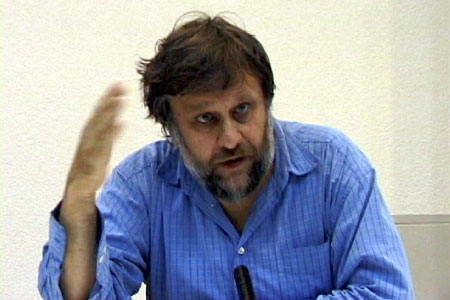
The recent controversy in the blogosphere, provoked by this critical review of Zizek in The New Republic, has me somewhat confused. It seems that the unanimous response is that the review is unfair, highly impoverished, and generally poor academic work. Yet branching from this central position, we get two qualifications. The first is critical of Zizek, and claims that, while Kirsch's article is a failure, we should nonetheless be skeptical of Zizek's apparent romantic adoration for totalitarian violence. The second, exemplified by Larval Subjects here, defends Zizek against this criticism, claiming that he is thoroughly an ironist, opting to defend the 'worst' option of totalitarianism in order to force us to reevaluate the basic ideological assumptions structuring the choice between political alternatives. The critical rejoinder to this defense is that, while irony is all well and good, we must be wary of the potential consequences of this 'worse choice', as the alternative potentials of traversing the ideological fantasy could be horrific. (For more on this debate, see the comments on LS's post.)
I don't think either position gets it right. First of all, for all the out-of-hand rejection of Kirsch's article, everyone seems to nonetheless accept its basic point - that Zizek is an apologist for, or even an advocate of, totalitarian violence. Yet anyone with a more than superficial familiarity with Zizek's work should know that, despite (or rather, because of) his championing of ruthless political Terror, and his praise of figures like Robespierre, Lenin, and Mao, his analyses of the latter are thoroughly critical. He does not advocate what they did, but attempts to show 1) what potentials still live on in the legacy of these figures, and 2) how these potentials were betrayed by the admittedly catastrophic outcomes of their actualization.
This criticism is captured in his seemingly tasteless claim that, while Hitler was a monster, and the genocide he presided over was one of the most disgusting episodes in human history, the problem with Hitler's 'revolution' was that it was not violent enough, in that it failed to undermine the basic symbolic coordinates of the situation. The shoah was hence an impotent passage à l'acte, a hideous acting out that only served to sustain the status quo. His praise of figures like Stalin and Mao, despite similar crimes on their parts, roots from the fact that they headed abortive, but nonetheless real and important, attempts to intervene at the level of the symbolic coordinates of the possible. The totalitarian repression and purges they carried out were symptoms of the failure of these attempts. The violent terror Zizek is advocating has nothing to do with these disgusting displays, and in fact, they would be proof that a Zizekian politics has failed to come to fruition.
The basic tenet of Zizek's conception of revolutionary politics is that, if a movement has to resort to murder, genocide, torture, and the like, then it's not a revolution at all. The revolutionary shift must occur at the level of symbolic foundations, such that enemies of the revolution wouldn't have to be forcibly silenced, as they would be fundamentally excluded from the field of discourse, such that their words and actions would have no more weight than those of a schizophrenic babbling to himself about conspiracies. In other words, the violence Zizek advocates is a kind of symbolic violence, and any resort to what he calls subjective violence, literally, injury and abuse sustained by actual persons, would be a sure sign of the failure of the former.
Does this amount to a prohibition of violent tactics altogether? Doesn't this conflict with his valorization of, for example, the looting and burning of supermarkets by the favela-dwellers in Rio de Janeiro as an instance of 'divine violence'? Here we must be clear: while we cannot rule out violence altogether, it should not be included in our tactical repertoire, but should be a desperate last resort, in the same way that a pro-choice advocate of sex-ed would not include abortion amongst the litany of birth control methods, but would reserve it for desperate situations. As for the example of Rio, or the Revolutionary Terror of 1792-4, how do we reconcile these with this logic?
The answer lies in the conception of divine violence as a break with the cycle of mythic violence, in which the revolutionary dissolution of an existing politico-legal structure is reduced to a means of establishing another to replace it. Yet if such a dissolution does not conclude with the institution of a new positive social order, how could it be more than a purely negative gesture? What is the future of a divine violence? In principle, the answer is that the very organization and mobilization that produces this dissolution must already be in-itself a new social bond, it must be enough to sustain society, as the 'embodiment of negativity'. In this way, the dissolution is not instrumentalized, reduced to being a means to some external end - the means should be enough.
The trouble with Zizek's examples is that they do not produce such results: they either collapse back into the previous order, as in Rio, or succeed in establishing a new Law, as in the French Revolution; or, where they do succeed, it is only temporary, as with the Shanghai Commune. Yet Zizek's point is more nuanced than such positivism. His point is that, even where divine violence is reduced to mythic violence, as a 'vanishing mediator', there is nonetheless a spectral remainder, a virtual element irreducible to its actualization - Kant calls it 'enthusiasm', Robespierre calls it 'generous ambition'. Moreover, it is the redemption of this spectral remainder that must serve, for Zizek, as the basis of any social bond that would escape the cycle of mythic violence. Here, Zizek is thoroughly Benjaminian. [Narcissistic side-note: if you've been following my blog, you'll recognize in this 'spectral remainder' precisely what I've been referring to as the 'ancestral dimension'.]
When Zizek does praise Terror, as in the cases of the French, October, or Cultural Revolutions, he is quite clear that his praise is aimed not at massive slaughter and repression, but rather, at the attempts at inventing new modes of sociality, new habits and rituals, to replace what had to be done with. He makes this point quite clearly in his recent work, In Defense of Lost Causes:
It is at this level that one should search for the decisive moment of a revolutionary process: say, in the case of the October Revolution, not the explosion of 1917-18, not even the civil war that followed, but the intense experimentation of the early 1920s, the (desperate, often ridiculous) attempts to invent new rituals of daily life: how to replace the pre-revolutionary marriage and funeral rites? How to organize the most commonplace interaction in a factory, in an apartment block? It is at this level of what, as opposed to the "abstract terror" of the "great" political revolution, one is tempted to call the "concrete terror" of imposing a new order on quotidian reality, that the Jacobins and both the Soviet and the Chinese revolutions ultimately failed - not for lack of attempts in this direction, for sure. The Jacobins were at their best not in the theatrics of Terror, but in the utopian explosions of political imagination apropos the reorganization of the everyday: everything was there, proposed in the course of the frantic activity condensed into a couple of years, from the self-organization of women to communal homes in which the old were to be able to spend their last years in peace and dignity. (Lost Causes, p 174-5)When Zizek praises these revolutions, and champions political terror, he is not referring to the 'abstract terror' of mass murder and totalitarian repression, but to the concrete terror of the reorganization of basic social relations. This, he claims, is the ultimate lesson of the Cultural Revolution:
Although a failure, the Great Proletarian Cultural Revolution (GPCR) was unique in attacking the key point: not just the takeover of state power, but the new economic organization and reorganization of daily life. Its failure was precisely the failure to create a new form of everyday life... (LC, p 205)Despite his recent claims that the Left should not shy away from appropriating State power, his point is that such actions must have a concrete transformation of the social bond as their 'base'. This is, consequently, how we can reconcile his notion of 'Bartleby politics' with the seemingly contradictory valorization of the 'great revolutions': withdrawal from activity means we must fundamentally reorganize the social substance of habits and rituals, organizations of jouissance, if active intervention is to be more than impotent acting out, or some custodial 'cleaning up after' capitalist excess.
Concrete terror, then, means immersing ourselves in a total experimentation with our social organization and habits. This follows from Zizek's definition of terror, which is basically that 'there is no going back':
Terror is this 'self-related' or 'self-negated' fear: it is what fear changes into once we accept that there is no way back, that what we are afraid to lose, what is threatened by what we are afraid of (nature, the life-world, the symbolic substance of our community...) has always-already been lost. (LC, p 434)Bartleby politics is thus not simply abstinence, not simply doing nothing, it is rather a matter of being nothing, of coming to embody this radical loss of ground or symbolic support, of becoming that intolerable, unproductive kernel inappropriable by Capital.
This reading of Zizek can also help shed light on the apparent hypocrisy of his advocacy of revolutionary politics, despite his complacent position as a well-off, jet-setting bourgeois intellectual. While I'm not denying this hypocrisy, I think we should recognize in it what he has referred to as a 'sincere hypocrisy': he is obliged to work explicitly in cultural theory and philosophy because intervention in the symbolic substance of culture must precede and 'ground' any potent political action. Here, I have great affinity with Levi Bryant's reading of Zizek as ironist, in his paper "Symptomal Knots and Evental Ruptures", and over at Larval Subjects. Moreover, despite his immense disdain for Guattari's influence on Deleuze, this is why I see Zizek as an important influence on schizoanalysis, as I understand it. Reorganization of social relations should not be imposed after the fact by a political regime, but must be the base and support preceding any mass political mobilization.
Friday, October 3, 2008
Schizoanalysis 1: Infancy, Ancestrality, and the Non-Signifier

A child is born into language, and is from the outset a speech-being, a speaking thing. The child is not without language, and does not have to be led to language, taught to acquire language, nor does it have already the innate capacity for language that has only to be activated. The child is already a speaking thing, not by virtue of speaking or being able to speak, but by already being claimed by language and in language, by belonging in language, having a place there for it. The name, but also the very noun - a child, a life - impregnates language with the child, and language will carry it to term, developing it in all of its unique predicability.
The paradox is that the child already belongs to and in language, it is already spoken of and awaited as the absent partner of a conversation. The child does not acquire language, we do not acquire language: language has already acquired us from birth. The trauma of this claim of language on the child is that there is no opportunity, no possibility of the pure incarnation of biological life, an unqualified, bare life; life is qualified from its outset, and biological life is overdetermined from the instant of conception by symbolic life, as its mere occasional cause and support.
Ancestrality, as the dimension of an existence unqualified by givenness in language, unfettered by the trappings of the symbolic, is nonetheless held hostage by its pre-appropriation in language. Yet we can say that the ancestrality of a life is, if not pre-given and auto-donated, certainly taken, taken over by and taken over to language, it is stolen, mis-taken and held inappropriately. It inheres in language as the inappropriate, the inappropriateness of language. Not the inadequateness of a representation to its object, but the fact that language now possesses the ancestral as its property, and yet it is not properly of language, it is wrongly taken by language or taken to be of language.
As a dimension not attributable to a relation to language, but that dimension existing absolutely independently of such relation, radically indifferent to such a relation, foreclosed to language, radically left out of and even inexistent for language, it would seem contradictory to call it a 'property' of language, even if this is an illegitimate propriety, a theft. Yet this means precisely that the foreclosure of the ancestral necessary for langauge nonetheless inheres negatively in language, as a hole in the very fabric of the symbolic (differential relations between signifiers). The ancestral inheres in language, but this inherence must be enacted through the circulation of some non-signifier, a symbol deprived of any possible signfying relation (direction toward a concept - signified - even if it be indeterminate or displaced), purely embodying the hole in this fabric, not only 'standing in for it' but enacting it. The hole is not something that cannot be signified by any signifier, but rather, a signifier that cannot signify anything, nor even appear to signify anything. The non-signifier simply explicates this hole of the foreclosure that is a necessary, though not sufficient, condition of the symbolic, radically psychoticizing the symbolic itself. It is the signifier of the fact that it is not a signifier, a kind of symbolic ouroboros.
The ancestral dimension of life, when seized upon by the symbolic, interpellated by it, decided upon by it, devolves into creaturely life (Santner), that life held in exception in law, subject to the force-of-law but unqualified by law. This is, we might say, the ancestral as such, distinct from the ancestral itself (Brassier, Laurelle). What law/language cannot speak to is the indistinction itself, it cannot think the creature/ancestor without its distinction and separation from the legible/legitimate. In other words, the ancestral itself is posited as unthinkable, only thinkable as such, that is, as distinct from the symbolic. It cannot think the radical expropiation undergone here: the ancestral no longer has a proper owner, being stolen and now owned inappropriately by language. We directly posit this necessary expropriation, this foreclosure of propriety to language. This is not to say that there is a proper being of the ancestral apart from language - this is the very decisional operation of language. Rather, what we are saying is that propriety itself is dependent upon determination by langauge, and at the same time the ancestral is necessarily determined in langauage by expropriation, determined as inappropriate.
This expropriation or foreclosure to language of the ancestral is enacted in language through the circulation of non-signifiers, or a-signifying signs that are not signifiers of a loss, even of something that exists qua signified/signifiable only as lost (the signified lost-object is the ancestral itself, the signifier of loss the ancestral as such); rather, the (non)-signifier is directly the loss itself, it embodies the foreclosure of the ancestral, and the hole this leaves in the symbolic, or rather, it enacts them, it brings them into (linguistic) being. This enacting of foreclosure, refusing to forget/overlook it and retaining it as unforgotten, repeating the founding decision of a linguistic social bond and recovering it from abandonment in an eternal past - this is the elementary task of schizoanalysis as an applied non-philosophy. Schizoanalysis accomplishes this task through the proliferation and circulation of non-signifiers or a-signifying signs.
We should see how, in the infant's appropriation by language, we nonetheless can identify a dimension of ancestral time, the time of an absolute anteriority, a time foreclosed to thought. We can take here as our model what Giorgio Agamben calls, in The Time that Remains, operational time. If we only ever experience time as schematized and organized into a past, present, and future, operational time is precisely the time it takes to apply this schema to intuition and hence experience time as such. Because this time is necessarily anterior to schematic time, it is foreclosed to schematic time, but nonetheless inheres negatively within it. The infant, who exists only as already symbolized, nonetheless is submitted to the operation of symbolization, and hence embodies a residual anteriority to the symbolic schematism. This is not pre-symbolic any more than operational time is pre-temporal. It is rather the symbolic itself as separated-without-separation from the symbolic schematized as such, which is to say, in thought.
Here we have, directly embodied in the infant (though negatively embodied), the ancestral dimension of language - the hieroglyph. This is a sign that acts a cipher, a code, but which obscures not some hidden content, but the very fact that nothing is hidden. It is a cipher of a cipher, a sign that disguises the very fact that it is a sign, or disguises the fact that it says anything (or nothing). This is a ruin of language, an artifact, a language without any connection to its ability to communicate. This hieroglyphic character is the original character of infant-speech, which only secondarily gives way to communication. Rather, the infant says language itself, as a pure impartibility without object. It is this character that we seek to recover through the use of the non-signifier, or the transfiguration of signifiers into non-signifiers.
Sunday, July 27, 2008
Like Father Like Son

Some notes following Giorgio Agamben's lecture, "The Power and the Glory".
Economy properly becomes a concern when the activity or actuality of a praxis, which is to say, an effectivity or efficacy, cannot be reconciled with the being to which it 'belongs'. We should be precise: it is not only the fact of an actuality or action, a 'having happened', an effect, but the facticity of efficacy or the ability to be effective, the power or potential to produce a desired or intended effect. Perhaps it is too much to say 'intended'. It is the facticity of efficacy in the effect, of the potential manifest in an actual effect to produce itself as the right one, the desired one, the appropriate, if not intended effect. In other words, we can say that the propriety of an effect does not belong to being to which it is ascribed, to its 'proper' cause, the cause of which it is a property. It rather holds within itself its own propriety as an immanent power.
Economy is already a form of leading or guiding, which is to say, arche. This is also beginning, in the sense of that which comes before us and goes before us, that which must precede us, in time as well as in space, standing before us to lead the way. We only ever follow after a beginning, we do not begin of ourselves but are preceded. Economy is the form in which the arche of the oikos - the pater - relates to his action of leading, in which the leader relates to the action of leading, through the son and the family, and then the possessions and property of the family, as that which follows from him. In the pater the abstract order of leading must relate to the specific instances of following, or rather, the being which leads must relate to its action of leading as itself manifest. The father intends not to keep the son within his propriety and rule, but to lead him to his own propriety, to the self-directed appropriation that he manifests.
In this sense, the son, as the enacting of leading in following, or of being in an actuality, cannot simply be reduced to the ground of the father's arche. The son must become groundless, self-sufficient, independent of his own beginning, he must exceed the boundary of paternal order and go beyond... The leadership of the father is ultimately aimed at leading the son beyond being led, beyond the being that leads, that stands before and is 'in beginning', 'in the beginning', 'at first'.
This of course is intended to reproduce the structure again, with the son assuming the position of the father, the self-grounded effect returning to the place of a cause, the act assuming the being to which it once belonged. This is not our problem. Our problem is within the structure of economy, not in the concrete reproduction of this structure. The problem is thus: the father, as the beginning from which the son comes, which comes before the son, must lead the son to become without beginning, an-arche, groundless and improper, or again, self-grounded and appropriate to itself and not another, beginning only from itself. Yet the father, not within the chain of concrete reproductions, but the very structural function of the father as beginning, leader, archon, must itself be without beginning, not lead by another or preceded by another, and thereby following after.
In the concrete occasion we may say that either the father has become without leadership after maturing, through being his father's son, or - and this is not necessarily incompatible with the former point - by creating the illusion, in the prerogative of the son, that there is nothing before him, that he is lead by no one, by blocking the way and all sight of what lies ahead. This would be a symbolic fiction, an effective illusion, with a certain pedagogical function. Yet this is not what concerns us at the moment. When such concern does arise, however, it would do us well to revisit, in this light, Deleuze and Guattari's analysis of familialism in Anti-Oedipus, which has for too long been cast as a polemical condemnation of psychoanalytic theory, rather than the precise engagement of a structure within that theory that it really is.
What is it, then, to say that the father qua beginning, archon, is without beginning, an-arche? In the structural sense, it amounts to saying that the beginning is without beginning, or without itself, outside of itself and lacking itself, missing itself in itself. This is not the same as saying that the beginning 'comes from nowhere', ex nihilo, but rather that the beginning does not have itself, does not possess itself, is improper to itself. To return to the terms with which we began, the principle of propriety by which an effect, as manifest, has the power to produce itself as proper or desired, that is to say, in its actuality to become what it was to-be; this principle is also present in the beginning, the being or ground of an effect, or it is reflected into this being once economy structures its relation to its actuality. Yet it is present there in an inverted form by which the beginning becomes improper to itself, in actuality becoming what it was not to-be.
This raises a question as relevant from the structural perspective as it is from the concrete perspective: what was before the father, before the beginning, if this beginning cannot have itself as itself, as its own beginning? What was the beginning before it became the beginning? Who was the father before he became a father, and what has now become of him, if he has apparently vanished?
Thursday, April 12, 2007
Deleuze and Guattari Quotes
Just a few forceful, affecting quotes from Chaosmosis and Difference and Repetition (by the way, I'm using the Continuum version of D&R, which has different page numbers than the standard, Columbia version):
"Production for the sake of production - the obsession with the rate of growth, whether in the capitalist market or in planned economies - leads to monstrous absurdities. The only acceptable finality of human activity is the production of a subjectivity that is auto-enriching its relation to the world in a continuous fashion." Chs 21
"There is an ethical choice in favor of the richness of the possible, an ethics and politics of the virtual that decorporealises and deterritorializes contingency, linear causality and the pressure of circumstances and significations which besiege us. It is a choice for processuality, irreversibility and resingularisation." Chs 29
"There are singular incorporeal constellations which belong to natural and human history and at the same time escape them by a thousand lines of flight." Chs 27
"So we are proposing to decentre the question of the subject onto the question of subjectivity. Traditionally, the subject was conceived as the ultimate essence of individuation, as a pure, empty, prereflexive apprehension of the world, a nucleus of sensibility, of expressivity - the unifier of states of consciousness. With subjectivity we place the emphasis instead on the founding instance of intentionality. This involves taking the relation between subject and object by the middle and foregrounding the expressive instance..." Chs 22
"...when we say that univocal being is related immediately and essentially to individuating factors, we certainly do not mean by the latter individuals constituted in experience, but that which acts in them as a transcendental principle: as a plastic, anarchic and nomadic principle, contemporaneous with the process of individuation, no less capable of dissolving and destroying individuals than of constituting them temporarily; intrinsic modalities of being, passing from one 'individual' to another, circulating and communicating underneath matters and forms. The individuating is not the simple individual." D&R 47-8
"Only the extreme forms return - those which, large or small, are deployed within the limit and extend to the limit of their power, transforming themselves and changing one into another." D&R 51
"Production for the sake of production - the obsession with the rate of growth, whether in the capitalist market or in planned economies - leads to monstrous absurdities. The only acceptable finality of human activity is the production of a subjectivity that is auto-enriching its relation to the world in a continuous fashion." Chs 21
"There is an ethical choice in favor of the richness of the possible, an ethics and politics of the virtual that decorporealises and deterritorializes contingency, linear causality and the pressure of circumstances and significations which besiege us. It is a choice for processuality, irreversibility and resingularisation." Chs 29
"There are singular incorporeal constellations which belong to natural and human history and at the same time escape them by a thousand lines of flight." Chs 27
"So we are proposing to decentre the question of the subject onto the question of subjectivity. Traditionally, the subject was conceived as the ultimate essence of individuation, as a pure, empty, prereflexive apprehension of the world, a nucleus of sensibility, of expressivity - the unifier of states of consciousness. With subjectivity we place the emphasis instead on the founding instance of intentionality. This involves taking the relation between subject and object by the middle and foregrounding the expressive instance..." Chs 22
"...when we say that univocal being is related immediately and essentially to individuating factors, we certainly do not mean by the latter individuals constituted in experience, but that which acts in them as a transcendental principle: as a plastic, anarchic and nomadic principle, contemporaneous with the process of individuation, no less capable of dissolving and destroying individuals than of constituting them temporarily; intrinsic modalities of being, passing from one 'individual' to another, circulating and communicating underneath matters and forms. The individuating is not the simple individual." D&R 47-8
"Only the extreme forms return - those which, large or small, are deployed within the limit and extend to the limit of their power, transforming themselves and changing one into another." D&R 51
Wednesday, April 11, 2007
Subjectivation and Economic Theory: A Brief Survey
For mainstream economists, subjectivity is understood as a given. (And who can blame them? It is the same for most of the human and social sciences, most of academia.) The tradition of moral philosophy from which economics was born provided the substance – a pre-Kantian subject overdetermined by uncritical conceptualizations of the time – which has been modified, supplemented, and articulated throughout the centuries by a whole host of theorists, but which has also maintained the same stiflingly orthodoxical makeup all along. Raising the matter of subjectivity is not a 'postmodern' conceit, nor is this matter epiphenomenal to the true science of economy. Rather, subjectivity is the very ground on which any foundation of the science and philosophy of economy must be built, and as such, the problem of its production, distribution, and consumption should be raised and negotiated wherever possible.
The reason I ascribe such an import to subjectivity and its production is precisely because it is only in and through these processes of production that we are able to act, that we are 'produced' as actors or agents. Thus a subjective production or 'subjectivation' is the condition of our reality as actors; it is the 'mode' of acting in which we become agents; it is agency. A production of subjectivity is simultaneously a production of agency, and agency is the cornerstone of economics. There is a fundamental subjective presupposition, an opinion (orthodoxy = “right opinion”), at the heart of the orthodox account of economic agency which ensures the consistency of economic theory as we know it: we all know what it is to have agency, to choose and decide, to desire and prefer, to think and act. Economists are therefore unwilling to question how these characteristics are produced, how they imply heterogeneous compositions of elements, be they individual and personal, familial, social, politico-legal, religious, linguistic, ecological, machinic, aesthetic, ethical, customary...
The orthodox account is content to homogenize subjectivity (capitalism produces a 'subjectivity of generalized equivalence', as Félix Guattari says), to disregard the heterogeneity of the factors and processes of its production, of its internal components and external connections. Yet we can see trends within economic theory that, while not directly challenging the subjective presuppositions, may lead us to engage the rich problematic of multifarious productions of subjectivity and agency, and the multiplicity of unique, singular subjectivations, as they relate to and indeed ground economic activity. We can already see such trends in the history of economic theory in the work of Marx and the institutionalist movement, and it seems that they are reemerging, in perhaps a less radical form, in the mainstream reappropriation of the latter movement known as 'neoinstitutionalism' (Marxian thought has itself suffered from an unfortunate 'orthodoxication', although the last few decades have also witnessed creative and aberrant appropriations thereof).
Douglass North, a neo-institutionalist, expresses such a trend in reviving the problem of incentive structures and their composition, against the assumption of perfect rationality, in his article “Economic Performance Through Time”. The processes of learning and development that produce individual subjects feed into the evolution and transformation of the social institutions in which they are involved and invested, and these institutions in turn react back on these subjects, shaping their own processes of change through limitation and facilitation. This reciprocal relation of production underlies the performance of economies, as it endows subjectivated persons and groups with the unique ensemble of habits, tools, and investments (of 'irrational' desires as much as 'rational' interests) that define its agency and hence its actions and decisions. Thus, North is able to raise the problem of transaction and information costs as primary in economic interactions, and to challenge the tendency in neoclassical theory to disregard them.
This impels us to think of markets in terms of the cost structures that they rest upon, which entails that truly 'efficient' markets are not the norm, but an exceptional case. Neoclassical theory tells us that information and the models in which we employ it may initially be imperfect, leading to significant cost structures, but that these will self-correct over time and tend towards perfection, thereby leading to negligible transaction costs. North rejects this: “Individuals typically act on incomplete information and with subjectively derived models that are frequently erroneous; the information feedback is typically insufficient to correct these models. Institutions are not necessarily or even usually created to be socially efficient; rather they, or at least the formal rules, are created to serve the interests of those with the bargaining power to create new rules.” [North, 359-60] This presents 'socially inefficient' institutions, and the detrimental power relations that breed them, as an obstacle to be overcome. Of course, this begs the question of whether 'correct models' are at all possible, at least in the traditional sense; perhaps if our information is always incomplete, our models always necessitating assumptions and chance, our desires and investments always confused and complicated, then we should think of models not in terms of an objective validity, but a functional efficacy and ethical consistency in relation to the subjectivations that engender them and whose processes of production they react upon.
Elsewhere, we can find the problem of the production of subjectivity raised in literature on geographic factors in economic composition [“Geography and Development” by Henderson, Shalizi, and Venables]. This article engages the question of unequal distributions of economic activity throughout the world, and subsequently investigates the forces and arrangements that produce dense, highly active clusters in some areas while neglecting and excluding other areas. “Why do so many economic decision takers choose to locate close to each other? And, for those who cannot locate in an economic center, what are the consequences of being outside, and possibly remote from, existing centers?” [Henderson et al, 81-2] Although they pose these questions in a geographic context, one should not take this as implying a 'geographical determinism'. Rather, they are investigating the geographic factors that are involved in certain processes of subjectivation, particularly urban and rural subjectivations. It is not that the actors do not 'choose for themselves', but that the decision that selects a choice is produced by the conjunction of many heterogeneous forces, components, and connections, a conjunction that is coextensive with the production of the 'agency' of the actors themselves; hence the emphasis on forces of agglomeration and dispersion and connections to the ‘outside’ – external markets, other regions, etc. – that condition the development of urban centers of subjectivation.
A third instance of this trend can be found in literature on international relations. Alexander Wendt gives us a promising formulation of the nature of State agency in his article "Anarchy Is What States Make of It". Rather than ascribing self-interested and self-serving egoism to some fundamental, eternal, primordial human nature, and hence reducing such attributes on the part of States to this nature (as the realist school is wont to do), Wendt rejects such easy answers. This is not to deny that egoistic structures of agency exist, but rather than ascribing these to a primordial nature, Wendt is interested in inquiring into how they are produced and constructed as such. Thus, rather than defining international anarchy (i.e. the fact that no central authority completely constrains the actions of States) negatively, as a default condition in which self-interested actors find themselves, he follows a positive definition that construes it as productive, possessing a 'causal power'. To understand the sense of this power, one must understand Wendt's constructivism. This prerogative sees knowledge as constructed by the ensemble of social forces, conditions, and customs in which it is situated, and this includes an actor's own self-knowledge, and hence his or her identity and interests. Knowledge does not relate to an objective, external reality, but rather only to a contingent and relative production of structures of agency.
Despite the emphasis on production, Wendt's constructivism seems to fall short of the potential force of the constructivist prerogative, insofar as it remains epistemological, that is, concerned with knowledge and its conditions. It does not call into question the construction of the subject of knowledge and the production of subjectivity itself; it begins with the subject presupposed, and with subjects as involved in social relationships through which meaning is constructed. This suffers from a relativism in which reality and the knowledge thereof are reduced to social conventions, and it thereby seems impotent as the basis for positive interventions into reality. We would prefer an ontological constructivism, one in which not only meaning and knowledge, but subjectivity itself, is constructed through converging productive processes. Reality is no longer reducible to or irrecoverable from socially relative conventions and meanings; rather, sociality and meaning are themselves results of the processes of production that make up reality. The emphasis is thereby no longer on knowledge and meaning as relative to the social conditions of a subject, but on functional connections and capacities as relative to the real conditions of subjective production or subjectivation. Meaning is only one (or several) field(s) constructed through such processes and implicated in subjectivations, but it is by no means the be-all end-all of the inquiry.
Shortcomings aside, Wendt does provide salient insights regarding the construction of State agency. Rather than deriving from an essence or nature of humanity, the dispositions, interests, and tendencies of States result from the processes of production with which they are involved: both the internal processes of their own constituencies, and the international processes of war, alliance, trade, and so on. States may often be disposed to self-interest, but we must explain how this disposition is produced, through what encounters, connections, and processes. In this sense, the anarchy of international relations is not a neutral default in which States express their essential nature, but a 'causal power' endowing States implicated in international encounters and relationships with a capacity to mutate, to produce new dispositions and interests, to alter the structures of agency involved, on the basis of the undetermined and open-ended nature of such relations.
In the literature on international relations, the trend can also be found in Kenneth Oye's article "The Conditions for Cooperation in World Politics". Oye's problem is basically how we might produce cooperation between States, and hence, States with an agency disposed toward cooperation rather than aggression, competition, or isolation. He isolates three different aspects of the process through which States become disposed toward each other, and hence in which their agency is produced. These are the payoff structure, which conditions the formation and prioritization of interests of parties involved in a cooperative relationship; the repeatability of a 'game' or encounter, and thus the duration of the relationship of the parties; and the number of parties involved in a game or encounter. Through these variables, he analyzes the conditions that facilitate or deter enduring cooperative relationships. These variables are aspects of the dispositions, that is, the structures of agency (what Wendt refers to as 'structures of identity and interest') thatmakeup State
These trends beg the question: how can a focus on the production of subjectivity reorient economic theory, and what are the potential trajectories for invention it draws within, and on the edges of, that field?
The reason I ascribe such an import to subjectivity and its production is precisely because it is only in and through these processes of production that we are able to act, that we are 'produced' as actors or agents. Thus a subjective production or 'subjectivation' is the condition of our reality as actors; it is the 'mode' of acting in which we become agents; it is agency. A production of subjectivity is simultaneously a production of agency, and agency is the cornerstone of economics. There is a fundamental subjective presupposition, an opinion (orthodoxy = “right opinion”), at the heart of the orthodox account of economic agency which ensures the consistency of economic theory as we know it: we all know what it is to have agency, to choose and decide, to desire and prefer, to think and act. Economists are therefore unwilling to question how these characteristics are produced, how they imply heterogeneous compositions of elements, be they individual and personal, familial, social, politico-legal, religious, linguistic, ecological, machinic, aesthetic, ethical, customary...
The orthodox account is content to homogenize subjectivity (capitalism produces a 'subjectivity of generalized equivalence', as Félix Guattari says), to disregard the heterogeneity of the factors and processes of its production, of its internal components and external connections. Yet we can see trends within economic theory that, while not directly challenging the subjective presuppositions, may lead us to engage the rich problematic of multifarious productions of subjectivity and agency, and the multiplicity of unique, singular subjectivations, as they relate to and indeed ground economic activity. We can already see such trends in the history of economic theory in the work of Marx and the institutionalist movement, and it seems that they are reemerging, in perhaps a less radical form, in the mainstream reappropriation of the latter movement known as 'neoinstitutionalism' (Marxian thought has itself suffered from an unfortunate 'orthodoxication', although the last few decades have also witnessed creative and aberrant appropriations thereof).
Douglass North, a neo-institutionalist, expresses such a trend in reviving the problem of incentive structures and their composition, against the assumption of perfect rationality, in his article “Economic Performance Through Time”. The processes of learning and development that produce individual subjects feed into the evolution and transformation of the social institutions in which they are involved and invested, and these institutions in turn react back on these subjects, shaping their own processes of change through limitation and facilitation. This reciprocal relation of production underlies the performance of economies, as it endows subjectivated persons and groups with the unique ensemble of habits, tools, and investments (of 'irrational' desires as much as 'rational' interests) that define its agency and hence its actions and decisions. Thus, North is able to raise the problem of transaction and information costs as primary in economic interactions, and to challenge the tendency in neoclassical theory to disregard them.
This impels us to think of markets in terms of the cost structures that they rest upon, which entails that truly 'efficient' markets are not the norm, but an exceptional case. Neoclassical theory tells us that information and the models in which we employ it may initially be imperfect, leading to significant cost structures, but that these will self-correct over time and tend towards perfection, thereby leading to negligible transaction costs. North rejects this: “Individuals typically act on incomplete information and with subjectively derived models that are frequently erroneous; the information feedback is typically insufficient to correct these models. Institutions are not necessarily or even usually created to be socially efficient; rather they, or at least the formal rules, are created to serve the interests of those with the bargaining power to create new rules.” [North, 359-60] This presents 'socially inefficient' institutions, and the detrimental power relations that breed them, as an obstacle to be overcome. Of course, this begs the question of whether 'correct models' are at all possible, at least in the traditional sense; perhaps if our information is always incomplete, our models always necessitating assumptions and chance, our desires and investments always confused and complicated, then we should think of models not in terms of an objective validity, but a functional efficacy and ethical consistency in relation to the subjectivations that engender them and whose processes of production they react upon.
Elsewhere, we can find the problem of the production of subjectivity raised in literature on geographic factors in economic composition [“Geography and Development” by Henderson, Shalizi, and Venables]. This article engages the question of unequal distributions of economic activity throughout the world, and subsequently investigates the forces and arrangements that produce dense, highly active clusters in some areas while neglecting and excluding other areas. “Why do so many economic decision takers choose to locate close to each other? And, for those who cannot locate in an economic center, what are the consequences of being outside, and possibly remote from, existing centers?” [Henderson et al, 81-2] Although they pose these questions in a geographic context, one should not take this as implying a 'geographical determinism'. Rather, they are investigating the geographic factors that are involved in certain processes of subjectivation, particularly urban and rural subjectivations. It is not that the actors do not 'choose for themselves', but that the decision that selects a choice is produced by the conjunction of many heterogeneous forces, components, and connections, a conjunction that is coextensive with the production of the 'agency' of the actors themselves; hence the emphasis on forces of agglomeration and dispersion and connections to the ‘outside’ – external markets, other regions, etc. – that condition the development of urban centers of subjectivation.
A third instance of this trend can be found in literature on international relations. Alexander Wendt gives us a promising formulation of the nature of State agency in his article "Anarchy Is What States Make of It". Rather than ascribing self-interested and self-serving egoism to some fundamental, eternal, primordial human nature, and hence reducing such attributes on the part of States to this nature (as the realist school is wont to do), Wendt rejects such easy answers. This is not to deny that egoistic structures of agency exist, but rather than ascribing these to a primordial nature, Wendt is interested in inquiring into how they are produced and constructed as such. Thus, rather than defining international anarchy (i.e. the fact that no central authority completely constrains the actions of States) negatively, as a default condition in which self-interested actors find themselves, he follows a positive definition that construes it as productive, possessing a 'causal power'. To understand the sense of this power, one must understand Wendt's constructivism. This prerogative sees knowledge as constructed by the ensemble of social forces, conditions, and customs in which it is situated, and this includes an actor's own self-knowledge, and hence his or her identity and interests. Knowledge does not relate to an objective, external reality, but rather only to a contingent and relative production of structures of agency.
Despite the emphasis on production, Wendt's constructivism seems to fall short of the potential force of the constructivist prerogative, insofar as it remains epistemological, that is, concerned with knowledge and its conditions. It does not call into question the construction of the subject of knowledge and the production of subjectivity itself; it begins with the subject presupposed, and with subjects as involved in social relationships through which meaning is constructed. This suffers from a relativism in which reality and the knowledge thereof are reduced to social conventions, and it thereby seems impotent as the basis for positive interventions into reality. We would prefer an ontological constructivism, one in which not only meaning and knowledge, but subjectivity itself, is constructed through converging productive processes. Reality is no longer reducible to or irrecoverable from socially relative conventions and meanings; rather, sociality and meaning are themselves results of the processes of production that make up reality. The emphasis is thereby no longer on knowledge and meaning as relative to the social conditions of a subject, but on functional connections and capacities as relative to the real conditions of subjective production or subjectivation. Meaning is only one (or several) field(s) constructed through such processes and implicated in subjectivations, but it is by no means the be-all end-all of the inquiry.
Shortcomings aside, Wendt does provide salient insights regarding the construction of State agency. Rather than deriving from an essence or nature of humanity, the dispositions, interests, and tendencies of States result from the processes of production with which they are involved: both the internal processes of their own constituencies, and the international processes of war, alliance, trade, and so on. States may often be disposed to self-interest, but we must explain how this disposition is produced, through what encounters, connections, and processes. In this sense, the anarchy of international relations is not a neutral default in which States express their essential nature, but a 'causal power' endowing States implicated in international encounters and relationships with a capacity to mutate, to produce new dispositions and interests, to alter the structures of agency involved, on the basis of the undetermined and open-ended nature of such relations.
In the literature on international relations, the trend can also be found in Kenneth Oye's article "The Conditions for Cooperation in World Politics". Oye's problem is basically how we might produce cooperation between States, and hence, States with an agency disposed toward cooperation rather than aggression, competition, or isolation. He isolates three different aspects of the process through which States become disposed toward each other, and hence in which their agency is produced. These are the payoff structure, which conditions the formation and prioritization of interests of parties involved in a cooperative relationship; the repeatability of a 'game' or encounter, and thus the duration of the relationship of the parties; and the number of parties involved in a game or encounter. Through these variables, he analyzes the conditions that facilitate or deter enduring cooperative relationships. These variables are aspects of the dispositions, that is, the structures of agency (what Wendt refers to as 'structures of identity and interest') that
These trends beg the question: how can a focus on the production of subjectivity reorient economic theory, and what are the potential trajectories for invention it draws within, and on the edges of, that field?
Tuesday, April 10, 2007
Becoming-Woman with Virginia Woolf
[This is rather personal, as it was written as a letter to a friend, but since the dominant theme is one of depersonalization and impersonal affects, it seems appropriate. The refrain of the impersonal should manage to exceed and transform the personal aspects. I'm going to expand my engagement with the concept of becoming-woman soon, including its inheritance from Lacan (affirming feminine jouissance, denying the once-and-for-all fixity of unconscious sexuation), and the oft perplexing claim that there is no 'becoming-man'.]
I've always had a rather distant relationship with feminism, feminist theory, and the like. To be honest, I've maintained a safe distance from most everything until only very recently, and so this instance is not peculiar. My forays into metaphysics over the last few years have given me new impetus and passion for intellectual exploration, and this has led inevitably to the rich field of feminist theory, the feminine in philosophy, etc. And yet, while the problematic of feminism has become far more important to me, and far more resonant or interconnected with my own, I must admit there remains a distance between myself and the field that I have yet to traverse.
Perhaps it has to do with the difficulty – indeed, the pain, the misery – that has always abided between myself and the women I have loved. And yet this difficulty, this distance, is to an extent inconsequential, as it hasn't prevented on my part encounters with the feminine that attain a consistency and force unlike that of theory, of history, of lust or love. Such encounters are definitive of my very soul, my ownmost, unstrippable passion. These have come and gone, more often than not with a haste that I regret, and they extend beyond those with femininity, reaching into musicality, animality, machination, schizophrenia, childishness, the cosmos...
What I'm referring to is becoming – a Nietzschean, Bergsonian, Deleuzo-Guattarian, and staunchly anti-Hegelian concept of becoming – that is, a becoming that is not bound by the being that becomes, nor by that which is 'coming-to-be'. The encounters I speak of are certainly not worldly, and never depended on any woman, 'real' or imaginary, whom I fantasized about becoming, any more than they depended on my own being a man. They are secret encounters, molecular, often imperceptible encounters, in which 'I' have become no less impersonal than 'a woman' I happen upon. Such encounters will have nothing of beings, of stable, fixed (id)entities: this molecular woman and this molecular man are swept away by a mutual becoming; they are no more than the singular forces unleashed, the irreducibly unique compositions drawn; a becoming whose 'origin' or 'goal' is unthinkable, as the man and the woman have become indiscernible in this singular constellation of force, motion, affect – a dance. This dance is not yours, not mine, nor is it reducible to the two of us as individuals, as it escapes our individuality, our definite attributes and identities, and carries us away.
Imagine my excitement, my joy, upon hearing Virginia Woolf express with such clarity the sense of the encounters, the becomings-feminine that have so blessed my meager existence. Please excuse me as I quote at length from A Room of One's Own [available online here; I'm quoting from part six]:
These encounters, these becomings that escape from being – but not without sweeping the beings involved into a pure dancing – they are so important to Woolf. As she says, “the mind has so great a power of concentrating at any point at any moment that it seems to have no single state of being. It can separate itself from the people in the street, for example, and think of itself as apart from them, at an upper window looking down on them. Or it can think with other people spontaneously, as, for instance, in a crowd...” The greatest power of the mind is that of becoming that emerges like a bloom from a chance encounter. It is this power to alter, to produce alterity, to set free a difference, a force of difference unbound from identity, “a force in things which one had overlooked”: this is what Woolf so profoundly discovers in concluding her discussion of 'women and fiction'. “Nothing is required to be held back.” This discovery impels her to question the stability of the categories of 'man' and 'woman', or the importance thereof, in the mind, that is, in this power of becoming and altering.
Then what, if not the binary opposition of identities? What characterizes gender, if we are not to carelessly disregard it? Her answer here is decisive: rather than an amateurish understanding that would see in every mind a struggle between some masculine and some feminine principle, a suppression of one by the other, she proposes an image of harmony and cooperation (as dancing requires) between the masculine and feminine, exemplified by the androgyne. Harmony does not reduce to either note, but involves a resonance between them, emerging from their encounter, that carries both into a new field of sonic potentiality (dissonance, consonance, the interval, song). Similarly, the power of androgyny is not in a simple imitation of one gender by the other, but rather in a capacity to free the elements, the forces and affects, of each gender, to give them free reign, to allow them to play, to dance, to compose and decompose within singular encounters. She takes Coleridge's claim that the mind is androgynous to mean just this: if the mind cannot free becomings-feminine and becomings-masculine from 'woman' and 'man', if it cannot become-other and affirm the chance of the encounter, it will be too rigid, too brittle, it will surely crack.
Androgyny thus becomes the highest, most brilliant power of gender and the thought of gender, the power with which they attain creativity, alterity, freedom. “[T]he androgynous mind is resonant and porous; ...it transmits emotion without impediment; ...it is naturally creative, incandescent and undivided.” What a radiant notion! Androgynous thought is thereby able to escape the binary distinction of man and woman in order to free the creative potentialities it so often stifles and suffocates. Indeed, there is a deathly air about such a clean cut duality:
I've always had a rather distant relationship with feminism, feminist theory, and the like. To be honest, I've maintained a safe distance from most everything until only very recently, and so this instance is not peculiar. My forays into metaphysics over the last few years have given me new impetus and passion for intellectual exploration, and this has led inevitably to the rich field of feminist theory, the feminine in philosophy, etc. And yet, while the problematic of feminism has become far more important to me, and far more resonant or interconnected with my own, I must admit there remains a distance between myself and the field that I have yet to traverse.
Perhaps it has to do with the difficulty – indeed, the pain, the misery – that has always abided between myself and the women I have loved. And yet this difficulty, this distance, is to an extent inconsequential, as it hasn't prevented on my part encounters with the feminine that attain a consistency and force unlike that of theory, of history, of lust or love. Such encounters are definitive of my very soul, my ownmost, unstrippable passion. These have come and gone, more often than not with a haste that I regret, and they extend beyond those with femininity, reaching into musicality, animality, machination, schizophrenia, childishness, the cosmos...
What I'm referring to is becoming – a Nietzschean, Bergsonian, Deleuzo-Guattarian, and staunchly anti-Hegelian concept of becoming – that is, a becoming that is not bound by the being that becomes, nor by that which is 'coming-to-be'. The encounters I speak of are certainly not worldly, and never depended on any woman, 'real' or imaginary, whom I fantasized about becoming, any more than they depended on my own being a man. They are secret encounters, molecular, often imperceptible encounters, in which 'I' have become no less impersonal than 'a woman' I happen upon. Such encounters will have nothing of beings, of stable, fixed (id)entities: this molecular woman and this molecular man are swept away by a mutual becoming; they are no more than the singular forces unleashed, the irreducibly unique compositions drawn; a becoming whose 'origin' or 'goal' is unthinkable, as the man and the woman have become indiscernible in this singular constellation of force, motion, affect – a dance. This dance is not yours, not mine, nor is it reducible to the two of us as individuals, as it escapes our individuality, our definite attributes and identities, and carries us away.
Imagine my excitement, my joy, upon hearing Virginia Woolf express with such clarity the sense of the encounters, the becomings-feminine that have so blessed my meager existence. Please excuse me as I quote at length from A Room of One's Own [available online here; I'm quoting from part six]:
At this moment, as so often happens in London, there was a complete lull and suspension of traffic. Nothing came down the street; nobody passed. A single leaf detached itself from the plane tree at the end of the street, and in that pause and suspension fell. Somehow it was like a signal falling, a signal pointing to a force in things which one had overlooked. It seemed to point to a river, which flowed past, invisibly, round the corner, down the street, and took people and eddied them along...Now it was bringing from one side of the street to the other diagonally a girl in patent leather boots, and then a young man in a maroon overcoat; it was also bringing a taxicab; and it brought all three together at a point directly beneath my window; where the taxi stopped; and the girl and the young man stopped; and they got into the taxi; and then the cab glided off as if it were swept on by the current elsewhere.
The sight was ordinary enough; what was strange was the rhythmical order with which my imagination had invested it; and the fact that the ordinary sight of two people getting into a cab had the power to communicate something of their own seeming satisfaction. The sight of two people coming down the street and meeting at the corner seems to ease the mind of some strain, I thought, watching the taxi turn and make off. Perhaps to think, as I had been thinking these two days, of one sex as distinct from the other is an effort. It interferes with the unity of the mind. Now that effort had ceased and that unity had been restored by seeing two people come together and get into a taxicab.
I can not express enough how this passage has affected me, and has given words to something that has escaped my own articulation. For what occurs in this chance encounter if not the very becoming of which I have spoken? It is not that the man 'acts like' a woman, imitates or impersonates a woman, any more than the reverse. It has as little to do with the man's being as such than with the woman's. There is a whole impersonal field of forces at play: a lull in traffic; a falling leaf; a passing taxi, a becoming-machinic; a becoming-river, a force of the river enters into composition with a force of the taxi and with a vague masculinity, a vague femininity, a becoming-feminine and becoming-masculine as forces that escape the persons and that invest and enter into composition with the entire field. There are attractions that have nothing to do with sexuality, or at least not as it is commonly understood.
These encounters, these becomings that escape from being – but not without sweeping the beings involved into a pure dancing – they are so important to Woolf. As she says, “the mind has so great a power of concentrating at any point at any moment that it seems to have no single state of being. It can separate itself from the people in the street, for example, and think of itself as apart from them, at an upper window looking down on them. Or it can think with other people spontaneously, as, for instance, in a crowd...” The greatest power of the mind is that of becoming that emerges like a bloom from a chance encounter. It is this power to alter, to produce alterity, to set free a difference, a force of difference unbound from identity, “a force in things which one had overlooked”: this is what Woolf so profoundly discovers in concluding her discussion of 'women and fiction'. “Nothing is required to be held back.” This discovery impels her to question the stability of the categories of 'man' and 'woman', or the importance thereof, in the mind, that is, in this power of becoming and altering.
Then what, if not the binary opposition of identities? What characterizes gender, if we are not to carelessly disregard it? Her answer here is decisive: rather than an amateurish understanding that would see in every mind a struggle between some masculine and some feminine principle, a suppression of one by the other, she proposes an image of harmony and cooperation (as dancing requires) between the masculine and feminine, exemplified by the androgyne. Harmony does not reduce to either note, but involves a resonance between them, emerging from their encounter, that carries both into a new field of sonic potentiality (dissonance, consonance, the interval, song). Similarly, the power of androgyny is not in a simple imitation of one gender by the other, but rather in a capacity to free the elements, the forces and affects, of each gender, to give them free reign, to allow them to play, to dance, to compose and decompose within singular encounters. She takes Coleridge's claim that the mind is androgynous to mean just this: if the mind cannot free becomings-feminine and becomings-masculine from 'woman' and 'man', if it cannot become-other and affirm the chance of the encounter, it will be too rigid, too brittle, it will surely crack.
Androgyny thus becomes the highest, most brilliant power of gender and the thought of gender, the power with which they attain creativity, alterity, freedom. “[T]he androgynous mind is resonant and porous; ...it transmits emotion without impediment; ...it is naturally creative, incandescent and undivided.” What a radiant notion! Androgynous thought is thereby able to escape the binary distinction of man and woman in order to free the creative potentialities it so often stifles and suffocates. Indeed, there is a deathly air about such a clean cut duality:
It is fatal to be a man or woman pure and simple; one must be woman–manly or man–womanly...And fatal is no figure of speech; for anything written with that conscious bias is doomed to death. It ceases to be fertilized. Brilliant and effective, powerful and masterly, as it may appear for a day or two, it must wither at nightfall; it cannot grow in the minds of others. Some collaboration has to take place in the mind between the woman and the man before the art of creation can be accomplished. Some marriage of opposites has to be consummated.This fertility that is affirmed in such a consummation must be rescued from the all-to-easy allusion to sexual intercourse and conception, as there is no longer a simple man, a simple woman, a simple act, but rather a complex dance between two androgynes (I say two, but each of them is already so many!). The fertility is becoming, and the consummation is the chance encounter that frees the forces so often captured and integrated by clear-cut identities. Such becomings-feminine as we find in the story of Shakespeare's sister, these are the stuff of creation, true creation. It is not a simple 'imagined' history, but rather draws out an androgynous trait from Shakespeare himself, a becoming that passes between him and Woolf in the proximity of their encounter. If anyone has shown the importance of becomings, and of becomings-feminine in particular, Woolf has done so here. I might say that my own discovery of these becomings, of this androgyny that clandestinely wanders across the territories of my existence, has been the most powerful and important experience for my own relationship with feminism and femininity in general. Whatever occurs when I do begin to traverse the 'safe distance' I've kept between myself and feminist theory and activism proper will surely involve these becomings-feminine, these androgynous encounters, that I've treasured so much.
Thursday, March 29, 2007
Proposal for Division III Project (Senior Thesis)
tentative title - Clandestine Agency: Blueprints for a Machinic Economy
areas of study - Philosophy, Economics
description - Economics has as its object of inquiry the arrangements of productive, allocative, and consumptive forces composing material and social life, and specifically those arrangements involving humanity as their defining element. The way in which this inquiry is conducted, as a scientific analysis of empirical phenomena on the one hand, and a prescriptive formulation of policy and strategy on the other, will depend upon the philosophic conception of the relation between the former and the latter. Thus the concepts involved and the models in which they have determinate relations both account for and actively shape the passage or movement between arrangements as existing, actual things available for analysis, and arrangement as the process of actualization by which things are produced and situated as such, and which we hope to guide and direct strategically.
The problem I wish to raise is twofold: what are the concepts and conceptual models employed by economic theory, constituting its frame of reference, both currently and historically? And how does it understand the process by which concepts are created or recreated and related in models that are then applied to the actual world? Such a research program will require analysis of the key concepts in economic theory, including agency, free will and choice, individuality, the nature of social bodies, markets, corporations, utility and desire, exchange and value. My hypothesis is that analyzing these concepts along with the processes that engender them and relate them to each other and empirical reality will shed light on overlooked potentials for the conceptual composition of economic theory. Perhaps there are modifications to be made to existing concepts, other concepts to be created or taken up, dynamic new models to draw, a superior consistency and practicality to be attained. Perhaps an emphasis on the process of conceptualization will give new impetus and new insight to the positive and normative aspects of economics, and make room for an ethics of economy at the very heart of the field.
I plan to survey the history of economic theory, from Smith, Ricardo, and Bentham to Jevons, Walras and Keynes, as well as the more neglected Marxian and Institutionalist lines, reading them through this double problem. I will draw on histories of economic thought, especially the fine accounts provided by Philip Mirowski, among others, in order to map the processes of conceptual modeling at work in these different thinkers. To chart alternative directions and possibilities for economic concepts and models, I will look to the pioneering work of Herbert Spencer on decision, agency, and rationality; Fernand Braudel's rich accounts of the historical processes composing economic reality; the growing literature on non-linear dynamics and dissipative structures in economic systems; and to a lesser extent, the approaches of World-Systems analysis and neo-institutionalism.
Finally, I will construct my overall approach, both the analytic and creative aspects, by using the works of philosophers Manuel DeLanda, Gilles Deleuze, Felix Guattari, and Michel Foucault. Their canons, particularly those of the latter three, are very difficult and specialized, but I am confident I can mobilize the relevant concepts in a manner that will be clear and comprehensible for readers without a strong background in philosophy and the specific niche they occupy. In this way, I hope to channel the inspiration and conceptual creativity I find in their works into a project that will be accessable to economists and offer a renewed approach to the field of economic theory.
areas of study - Philosophy, Economics
description - Economics has as its object of inquiry the arrangements of productive, allocative, and consumptive forces composing material and social life, and specifically those arrangements involving humanity as their defining element. The way in which this inquiry is conducted, as a scientific analysis of empirical phenomena on the one hand, and a prescriptive formulation of policy and strategy on the other, will depend upon the philosophic conception of the relation between the former and the latter. Thus the concepts involved and the models in which they have determinate relations both account for and actively shape the passage or movement between arrangements as existing, actual things available for analysis, and arrangement as the process of actualization by which things are produced and situated as such, and which we hope to guide and direct strategically.
The problem I wish to raise is twofold: what are the concepts and conceptual models employed by economic theory, constituting its frame of reference, both currently and historically? And how does it understand the process by which concepts are created or recreated and related in models that are then applied to the actual world? Such a research program will require analysis of the key concepts in economic theory, including agency, free will and choice, individuality, the nature of social bodies, markets, corporations, utility and desire, exchange and value. My hypothesis is that analyzing these concepts along with the processes that engender them and relate them to each other and empirical reality will shed light on overlooked potentials for the conceptual composition of economic theory. Perhaps there are modifications to be made to existing concepts, other concepts to be created or taken up, dynamic new models to draw, a superior consistency and practicality to be attained. Perhaps an emphasis on the process of conceptualization will give new impetus and new insight to the positive and normative aspects of economics, and make room for an ethics of economy at the very heart of the field.
I plan to survey the history of economic theory, from Smith, Ricardo, and Bentham to Jevons, Walras and Keynes, as well as the more neglected Marxian and Institutionalist lines, reading them through this double problem. I will draw on histories of economic thought, especially the fine accounts provided by Philip Mirowski, among others, in order to map the processes of conceptual modeling at work in these different thinkers. To chart alternative directions and possibilities for economic concepts and models, I will look to the pioneering work of Herbert Spencer on decision, agency, and rationality; Fernand Braudel's rich accounts of the historical processes composing economic reality; the growing literature on non-linear dynamics and dissipative structures in economic systems; and to a lesser extent, the approaches of World-Systems analysis and neo-institutionalism.
Finally, I will construct my overall approach, both the analytic and creative aspects, by using the works of philosophers Manuel DeLanda, Gilles Deleuze, Felix Guattari, and Michel Foucault. Their canons, particularly those of the latter three, are very difficult and specialized, but I am confident I can mobilize the relevant concepts in a manner that will be clear and comprehensible for readers without a strong background in philosophy and the specific niche they occupy. In this way, I hope to channel the inspiration and conceptual creativity I find in their works into a project that will be accessable to economists and offer a renewed approach to the field of economic theory.
Wednesday, March 28, 2007
Critique and the 'Critical Point'
In Parables for the Virtual, Massumi says,
Instead of responding to the solutions, the conclusions, the propositions of an argument, rejecting or accepting them, falling into a rigid binary, 'fostering' would seek out the problems, the complex problematic fields, of which the solutions are only effects. It would seek to rediscover the force of these problems, buried under calcified layers of understanding. The reader would negotiate these fields, these 'complexions', in order to find those sites of the most intense resonance between the constellations of problems composing the field and those composing the reader's own complexion. These are the sites of 'forced movement', where difference itself opens up in the new, in the line of flight. Here we might find a nomadic distribution of problems and solutions, the immanent evaluations of the Overman, of an Ethics. There is no longer an issue of interpreting and judging a representation, nor of representing one's reaction. Critique is no longer that of the conclusions, of what they represent as being 'good or bad', 'right or wrong', 'true or false'.
Critique has become a gathering of forceful problems selected in and of, by and for the encounter between two complexions, raising their intensities to the critical threshold at which something new and different can emerge: new arrangements of problems, new pathways of solution, new connections with the outside. This emergence marks the overturning of everything implicated insofar as it becomes distributed in a field of differences, a smooth space. The theme of emergence is what leads me to quote Massumi, as the notion of the 'critical point' is precisely the threshold of intensity that, once crossed, opens onto an emergence of the new. Critique in the mode of 'fostering' would seek to map out these critical points, the points of transformation of formalizations of expression.
These points are nodes of 'machinic heterogenesis', as Guattari says, autopoietic nuclei that enter catalytic relations with expressive traits, the intensive features of a machine. These nodes or singularities constitute the 'critical points' of a structure (regime of signs), which, in forming catalytic couplings with elements of that structure (expressive traits), generate machinic arrangements that open onto other orders, other 'Universes of values'. This generation or heterogenesis is precisely where the biunivocality of content and expression imposed by stratafication gives way to intensive order of matter/sense or the plane of consistency: there is a double transversality, as the singularities of content (nodes or critical points) deterritorialize the form of expression (structure), and the traits of expression (machinic components, intensive features) deterritorialize the form of content (Universes, constellations of singularities composing the diagram or 'virtuality' of a structure).
Cartography has a double edge: mapping the singular nodes embedded in a structural order, marking points of potential transformation and machinic heterogenesis, points at which several different structural orders can become involved in a conjunction that belongs to a machinic order that is different in kind from structure; and diagramming the expressive traits that engage these nodes and are catalyzed by them, opening onto new 'Universes', new constellations of traits, new permutations of the machinic phylum. This twofold function should thereby shed light on the abstract machines at play, by mapping the domain in which they can function and diagramming the range of functional possibilities they manifest. The abstract machine can only act in the concrete arrangements formalized by expression, by the 'regimes' or 'structures' left cooling, stratifying, in the wake of the machinic phylum. Yet the abstract machine has open to it an unlimited resevoir of virtual components and their possible functions, defined by the Universes, the diagrams, the constellations of singularities drawn by the very cutting edges of the phylum.
Together, these functions work to elucidate the machinic plane of consistency which the abstract machines traverse, the whole intensive and micrological order underlying and conditioning the order of structures, regimes of expression, molar signifiance and subjectification (representation and identity). By mapping the critical points or nodes of transformation, and diagramming the machinic components that can engage them and open a bifurcation, planomenology will be attentive to the dynamic and singular arrangements composed by any given encounter. The critical points are those particles of content embedded in expressive formalizations that have the potential to destabilize and mutate that formalization. The machinic components are those particles of expression that constellate around the edges of the diagram of content, composing those most deterritorialized functional arrangements that open onto new Universes and new diagrammatic configurations. The simplest example pertaining to the reading of a work of philosophy would have the critical points as those promiscuous concepts or ambiguous propositions that have the most potential to overturn a reading and allow it involve several other 'understandings', or even invent new ones, while the machinic components would be those ideas, problems, interpretative tendencies, 'frames of reference', even delirious 'misunderstandings' of the reader that can potentially open the text onto new fields of reference and orientation.
Planomenology would necessitate a 'fostering' of critical points, singularities, autocatalytic nuclei and the heterogeneous machinic components that engage them and compose autopoietic arrangements. This requires a very different sense of 'critique': rather than attacking the logic of the propositions of an argument, one intensifies the catalytic couples constellated by critical points until they cross the threshold of transformation, reaching 'critical' intensity, bifurcating and giving rise to an unpredictable and genuine difference through the selective actualization of virtualities. Rather than judging and implicitly moralizing, leveling the differences, desingularizing the problems, subordinating the unique to the identity of a model, it would seek to create an ethos, that is, to bring forth the singular problematic of an encounter or event. Only by negotiating such a problematic in its irreducible singularity is the liberation of the new, the affirmation of chance, possible. Only by analyzing 'how it makes us think' as Jason says, how it composes or is itself a composition of thought and action, of matter/sense, will we attain the absolute singularity of an ethical evaluation, free from the moralizing judgment of representation and argument.
Affect or intensity in the present account is akin to what is called a critical point, or a bifurcation point, or singular point, in chaos theory and the theory of dissipative structures. This is the turning point at which a physical system paradoxically embodies multiple and normally mutually exclusive potentials, only one of which is "selected." [32]This notion of the 'critical point' can help shed light on a mode of reading, approaching, and critiquing a philosophical work that does not fall into the traps of representation. A few days ago, I wrote some rough comments in response to this post from Zoēpolitics, which I'll elaborate on here. I was particularly responding to these statements:
"What if instead of reading these thinkers in terms of whether we agree or disagree with them, instead we were to consider the more general question of 'how they make us think'? What if, in other words, we were to read them against the grain of how they are 'normally' interpreted, in order to tease out the alternative potentialities they unlock?...In short, what if instead of spending so much time 'debunking' we were to 'foster' instead (Massumi)?"'Fostering' certainly seems more fruitful, productive, and interesting than 'debunking'. The former seems to correspond to the affirmative sense of critique that Deleuze finds in Nietzsche, the latter to critique as Lyotard construes it in Libidinal Economy: caught hopelessly in the representational space of the prerogative being critiqued. The former rescues the most forceful and explosive particles from the thing criticized, engaging them with expressive traits that are themselves drawn out by the most forceful lines of the reader. Rather than sterilizing both in an ineffectual representation with only the most banal effects, it selects that which can escape such sterility, that which can free itself and fly into a pure differing, a pure creation, that which draws both into a becoming-other. It is a joyous affirmation of a difference in-between the reader and what was read. Only such an affirmation can bring forth something 'new' in the most extreme and authentic sense, the sense of attaining absolute deterritorialization.
Instead of responding to the solutions, the conclusions, the propositions of an argument, rejecting or accepting them, falling into a rigid binary, 'fostering' would seek out the problems, the complex problematic fields, of which the solutions are only effects. It would seek to rediscover the force of these problems, buried under calcified layers of understanding. The reader would negotiate these fields, these 'complexions', in order to find those sites of the most intense resonance between the constellations of problems composing the field and those composing the reader's own complexion. These are the sites of 'forced movement', where difference itself opens up in the new, in the line of flight. Here we might find a nomadic distribution of problems and solutions, the immanent evaluations of the Overman, of an Ethics. There is no longer an issue of interpreting and judging a representation, nor of representing one's reaction. Critique is no longer that of the conclusions, of what they represent as being 'good or bad', 'right or wrong', 'true or false'.
Critique has become a gathering of forceful problems selected in and of, by and for the encounter between two complexions, raising their intensities to the critical threshold at which something new and different can emerge: new arrangements of problems, new pathways of solution, new connections with the outside. This emergence marks the overturning of everything implicated insofar as it becomes distributed in a field of differences, a smooth space. The theme of emergence is what leads me to quote Massumi, as the notion of the 'critical point' is precisely the threshold of intensity that, once crossed, opens onto an emergence of the new. Critique in the mode of 'fostering' would seek to map out these critical points, the points of transformation of formalizations of expression.
These points are nodes of 'machinic heterogenesis', as Guattari says, autopoietic nuclei that enter catalytic relations with expressive traits, the intensive features of a machine. These nodes or singularities constitute the 'critical points' of a structure (regime of signs), which, in forming catalytic couplings with elements of that structure (expressive traits), generate machinic arrangements that open onto other orders, other 'Universes of values'. This generation or heterogenesis is precisely where the biunivocality of content and expression imposed by stratafication gives way to intensive order of matter/sense or the plane of consistency: there is a double transversality, as the singularities of content (nodes or critical points) deterritorialize the form of expression (structure), and the traits of expression (machinic components, intensive features) deterritorialize the form of content (Universes, constellations of singularities composing the diagram or 'virtuality' of a structure).
Cartography has a double edge: mapping the singular nodes embedded in a structural order, marking points of potential transformation and machinic heterogenesis, points at which several different structural orders can become involved in a conjunction that belongs to a machinic order that is different in kind from structure; and diagramming the expressive traits that engage these nodes and are catalyzed by them, opening onto new 'Universes', new constellations of traits, new permutations of the machinic phylum. This twofold function should thereby shed light on the abstract machines at play, by mapping the domain in which they can function and diagramming the range of functional possibilities they manifest. The abstract machine can only act in the concrete arrangements formalized by expression, by the 'regimes' or 'structures' left cooling, stratifying, in the wake of the machinic phylum. Yet the abstract machine has open to it an unlimited resevoir of virtual components and their possible functions, defined by the Universes, the diagrams, the constellations of singularities drawn by the very cutting edges of the phylum.
Together, these functions work to elucidate the machinic plane of consistency which the abstract machines traverse, the whole intensive and micrological order underlying and conditioning the order of structures, regimes of expression, molar signifiance and subjectification (representation and identity). By mapping the critical points or nodes of transformation, and diagramming the machinic components that can engage them and open a bifurcation, planomenology will be attentive to the dynamic and singular arrangements composed by any given encounter. The critical points are those particles of content embedded in expressive formalizations that have the potential to destabilize and mutate that formalization. The machinic components are those particles of expression that constellate around the edges of the diagram of content, composing those most deterritorialized functional arrangements that open onto new Universes and new diagrammatic configurations. The simplest example pertaining to the reading of a work of philosophy would have the critical points as those promiscuous concepts or ambiguous propositions that have the most potential to overturn a reading and allow it involve several other 'understandings', or even invent new ones, while the machinic components would be those ideas, problems, interpretative tendencies, 'frames of reference', even delirious 'misunderstandings' of the reader that can potentially open the text onto new fields of reference and orientation.
Planomenology would necessitate a 'fostering' of critical points, singularities, autocatalytic nuclei and the heterogeneous machinic components that engage them and compose autopoietic arrangements. This requires a very different sense of 'critique': rather than attacking the logic of the propositions of an argument, one intensifies the catalytic couples constellated by critical points until they cross the threshold of transformation, reaching 'critical' intensity, bifurcating and giving rise to an unpredictable and genuine difference through the selective actualization of virtualities. Rather than judging and implicitly moralizing, leveling the differences, desingularizing the problems, subordinating the unique to the identity of a model, it would seek to create an ethos, that is, to bring forth the singular problematic of an encounter or event. Only by negotiating such a problematic in its irreducible singularity is the liberation of the new, the affirmation of chance, possible. Only by analyzing 'how it makes us think' as Jason says, how it composes or is itself a composition of thought and action, of matter/sense, will we attain the absolute singularity of an ethical evaluation, free from the moralizing judgment of representation and argument.
Sunday, March 25, 2007
What is Planomenology?
I pose the question only provisionally, as I hope to continue approaching it throughout my life, but it is perhaps an appropriate way to begin. The obvious cue is to phenomenology (as well as phantasmatology, a word Foucault coined to describe Deleuze's early metaphysics). Yet whereas Husserl intended phenomenology as methodological, I do not mean this to denote a method per se; rather, an approach to or prerogative on the ontological. Short of being systematic and exact, it should be anexact yet rigorous.
'Planomenon' is another word for the plane of consistency, perhaps the key concept in Deleuze and Guattari's later collaborations. The Planomenon is the Real as such, the ultimate 'object' of ontology, as the univocal Being of difference itself. It is the field of immanent difference, in which immanence is not ascribed to or said of any transcendent Identity or Actuality: immanence is immanent to immanence alone. Difference is no longer caught between the field of immanence and that to which it is immanent, thereby inscribed in the 'concept in general'. Rather, immanence differs from itself, in itself, by and for itself. This plane describes a field of pure differences or disparities, in which every term is a singularity - unique, unusual, problematic. It is on this plane that every singularity is consistent with every other, precisely as problems, as instances of a problematic field drawn in the course of questioning.
This kind of consistency is prior to and more profound than logical consistency, as contradiction has no meaning or relevance. Rather, it has a properly machinic consistency, that of the Mechanosphere: everything subsists in interconnected lines of flows and breaks, composed of a univocal flow of matter/sense (mening), a pure becoming. As such, it attains absolute deterritorialization, it is the real attaining this absolute limit. This occurs when the question, "What can this body do?", "Of what is this body capable?", is posed with its maximum force and efficacy, drawing a field that implicates and encompasses the entirety of the real. Every connection (of different to different, singularity to singularity) is raised to the height, the limit of its intensity. All of reality is constellated in a becoming-other of Being in which everything takes flight.
The machinic consistency of the Planomenon is thereby drawn not through a logical relation of terms without contradiction, but through a problematic relation of terms without limit, or whose only limit is the absolute of universal bifurcation in which everything is only as yet to come. The real becomes self-consistent in relation to what it can do, what might be coming. Therefore, planomenology will regard the real with an attention to such consistency, following the abstract lines drawn by absolute deterritorialization. Everything transcendent, every actuality, will come up against a force, a cruelty, so intense that it will attain its absolute limit, its vertigo, falling back on the plane of immanence. It is in this sense that Deleuze speaks of the 'transcendent exercise' of the faculties, in which they attain the pure immanence of a thought without image. Nothing can escape, or rather, nothing can avoid escaping, nothing can remain grounded on a substratum, as everything is carried off in a incessant and ruthless ungrounding.
'Planomenon' is literally defined as 'all free-living organisms; those organisms not rooted or attached to a substratum.' Its Greek root has the sense of 'drifting' or 'roaming', and it is related to 'planomania', meaning 'a compulsion to wander', or 'an intense desire to live free from social restraints or obligations'. It is when the question (of what are we capable?) is posed with sufficient force, that is, when there is an intense enough desire driving it, that absolute deterritorialization is attained, and the abstract line carries us off with an infinite speed. Discovering these lines and feeding them into the questioning, and thereby composing problematic machines with increasingly intense forced movements fueling them, is the aim and passion of planomenology. The object of planomenology is, therefore, the abstract line that clandestinely wanders through all of the real, connecting everything back to the univocal Being of difference, absolute Deterritorialization.
'Planomenon' is another word for the plane of consistency, perhaps the key concept in Deleuze and Guattari's later collaborations. The Planomenon is the Real as such, the ultimate 'object' of ontology, as the univocal Being of difference itself. It is the field of immanent difference, in which immanence is not ascribed to or said of any transcendent Identity or Actuality: immanence is immanent to immanence alone. Difference is no longer caught between the field of immanence and that to which it is immanent, thereby inscribed in the 'concept in general'. Rather, immanence differs from itself, in itself, by and for itself. This plane describes a field of pure differences or disparities, in which every term is a singularity - unique, unusual, problematic. It is on this plane that every singularity is consistent with every other, precisely as problems, as instances of a problematic field drawn in the course of questioning.
This kind of consistency is prior to and more profound than logical consistency, as contradiction has no meaning or relevance. Rather, it has a properly machinic consistency, that of the Mechanosphere: everything subsists in interconnected lines of flows and breaks, composed of a univocal flow of matter/sense (mening), a pure becoming. As such, it attains absolute deterritorialization, it is the real attaining this absolute limit. This occurs when the question, "What can this body do?", "Of what is this body capable?", is posed with its maximum force and efficacy, drawing a field that implicates and encompasses the entirety of the real. Every connection (of different to different, singularity to singularity) is raised to the height, the limit of its intensity. All of reality is constellated in a becoming-other of Being in which everything takes flight.
The machinic consistency of the Planomenon is thereby drawn not through a logical relation of terms without contradiction, but through a problematic relation of terms without limit, or whose only limit is the absolute of universal bifurcation in which everything is only as yet to come. The real becomes self-consistent in relation to what it can do, what might be coming. Therefore, planomenology will regard the real with an attention to such consistency, following the abstract lines drawn by absolute deterritorialization. Everything transcendent, every actuality, will come up against a force, a cruelty, so intense that it will attain its absolute limit, its vertigo, falling back on the plane of immanence. It is in this sense that Deleuze speaks of the 'transcendent exercise' of the faculties, in which they attain the pure immanence of a thought without image. Nothing can escape, or rather, nothing can avoid escaping, nothing can remain grounded on a substratum, as everything is carried off in a incessant and ruthless ungrounding.
'Planomenon' is literally defined as 'all free-living organisms; those organisms not rooted or attached to a substratum.' Its Greek root has the sense of 'drifting' or 'roaming', and it is related to 'planomania', meaning 'a compulsion to wander', or 'an intense desire to live free from social restraints or obligations'. It is when the question (of what are we capable?) is posed with sufficient force, that is, when there is an intense enough desire driving it, that absolute deterritorialization is attained, and the abstract line carries us off with an infinite speed. Discovering these lines and feeding them into the questioning, and thereby composing problematic machines with increasingly intense forced movements fueling them, is the aim and passion of planomenology. The object of planomenology is, therefore, the abstract line that clandestinely wanders through all of the real, connecting everything back to the univocal Being of difference, absolute Deterritorialization.
Subscribe to:
Posts (Atom)


 Posts
Posts


