philosophy as not philosophy: para-ontology, hauntology, schizoanalysis

"Articulating the past historically does not mean recognizing it ‘the way it really was’. It means appropriating a memory as it flashes up in a moment of danger. Historical materialism wishes to hold fast that image of the past which unexpectedly appears to the historical subject in a moment of danger. The danger threatens both the content of the tradition and those who inherit it. For both, it is one and the same thing: the danger of becoming a tool of the ruling classes. Every age must strive anew to wrest tradition away from the conformism that is working to overpower it. The Messiah comes not only as the redeemer; he comes as the victor over the Antichrist. The only historian capable of fanning the spark of hope in the past is the one who is firmly convinced that even the dead will not be safe from the enemy if he is victorious. And this enemy has never ceased to be victorious."
- Walter Benjamin, Thesis VI

"The materialist doctrine concerning the changing of circumstances and upbringing forgets that circumstances are changed by men and that it is essential to educate the educator himself. This doctrine must, therefore, divide society into two parts, one of which is superior to society. The coincidence of the changing of circumstances and of human activity or self-changing can be conceived and rationally understood only as revolutionary practice."
- Karl Marx, Thesis III

Showing posts with label Spinoza. Show all posts

Sunday, January 11, 2009

Object-ions: Cutting the Cord


Between Levi Bryant's fascinating posts on what he call's "The Ontic Principle", and Graham Harman's new blog "Object-Oriented Philosophy", I've found myself mulling over some objections. Now, I'm not yet familiar enough with either Harman or Latour, so perhaps these objections have already been anticipated, and if anyone can point me toward the relevant literature I'd appreciate it. But it strikes me that 'object-oriented philosophy' is missing something crucial. I touched upon this a bit in my last post, but there I was more concerned with sketching my own concepts, whereas here I'm a bit more critical.

First of all, while I have some sympathy for the urge to simply forget about correlationsim and pounce on the things themselves, I worry that this may be hasty and somewhat reckless. We can raise here a whole set of problems. Firstly, can we simply forget about Kant, who so famously demonstrated our consignment to the phenomenal world of access, and exlcusion from the in-itself? Secondly, who is to say that 'object' is an appropriate way of speaking about the in-itself? Are not objects the specific way things show up for us? If we subtract ourselves from the equation, what reason do we have to believe that objects will remain as objects?

Again, I'm not familiar enough with Harman to know how he would respond, but I am a bit confused by Levi's willingness to embrace objects as the form of the in-itself. This confusion stems from the high regard I have for his fantastic book on Deleuze, which, among other things, critiques any approach to the given that takes it as it is, rather than accounting for the genesis of that given. It seems to me that, from this position, we should arrive not at an object oriented philosophy any more than a subject oriented philosophy, but rather, at a genesis oriented philosophy, aiming to account for the givenness of the in-itself as objectal and accessible or inaccessible.

Now, Levi does lean in this direction with his explicit formulations, but I don't think he's yet made it altogther clear where he stands. For example, his ontic principle claims that "there is no difference that does not make a difference". He explicates this in conversation with Harman by saying that the object is the difference it produces in relation with objects, and moreover, that this differenciation is inexhaustible, the very inexhaustable being of the object in-itself. The object is nothing more than its potential to produce difference, its virtual power to differenciate. Harman, however, responds by claiming that there would still be something of the object even if it produced no difference, even if it was entirely without relation.

It is still unclear whether Levi thinks there is no object apart from its relations, that it is retroactively produced by its differenciation, or whether there is some substantial being of difference behind it; he has said of the virtual that it is nothing but relations amongst actualities, so the latter option seems unlikely. The option I assume he'd vie for, given his definition of the object as act-uality, is that the object is the difference produced in the wake of an event (in Deleuze's sense), and that this event is the only 'substantial' thing there (although substantial is the wrong term).

This ambiguity is clear in the very formulation of the ontic principle: there is no difference that does not make a difference. This is a negative existential statement, making a definite claim about what does not exist. So, what does exist would have to meet the following criteria: if it is a difference, it would have to make a difference. How do we read this? On the one hand, it could mean that a difference always produces another difference, and difference itself minimally occurs between two differences (this is not to be read as external or empirical difference, but the between of a mutual production, as the space between two connected singularities). On the other hand, it could mean that a difference, as a difference, produces itself as a difference. To be clear, this would mean that something different, by virtue of being different, produces the very difference that defines it as a being. In other words, the object-difference produces itself not only as a specific difference in relations with other objects, but, qua difference, as an existing object.

Both readings seem close to Levi's explication, but both have problems. With the first, we have the problem of an ulterior condition: if an object-difference, i.e. an existing being, by virtue of existing, produces other differences, which, again, by virtue of existing, produce other differences, we seem to be dangerously close to lapsing into the kind of transitive causality that Levi's Spinozism should avoid. If we are to avoid it, we must refer to an ulterior condition or immanent causality by which a difference produces itself as difference. Yet this would mean that, in producing itself, the ulterior condition is one of identity, in which the difference makes a non-difference, produces what already is - itself qua object-difference. Now I think these problems can be countered by reference to Deleuze's model of repetition and identity qua product, but this leads us to the second problem.

The second reading seems to refer to such an ulterior condition in which a difference is its own immanent cause, producing itself as an identity, as an identifiable object(-difference). Yet here we have the problem of treating a difference as object - the object-difference must preexist itself in some fashion, it must produce itself, which means it must exist before it exists. On the one hand, the difference must already be there to produce itself as object-difference. On the other hand, the object-difference must retroactively posit itself as its own cause, there at its own birth, so to speak. This temporal paradox will lead us back to a kind of transitive causation, unless we can provide a non-chronological account of production, an immanent production that occurs in being. Here, again, I think Deleuze can help answer these problems with his account of static genesis, and Levi surely knows this if anyone does.

Yet there is a third reading of the ontic principle that could undermine the apparent consistency of the Deleuzian approach, and I believe it is a reading that would fit Harman's own variant of object-orientation. If there does not exist a difference that does not make a difference, that nonetheless means that there could exist a non-difference that does not make a difference. Levi's ontic principle says nothing about the non-existence of non-differences (and here I suspend the strict identification of non-difference and identity). If Levi is attempting to provide a robust, and parsimonius, theory of object-differences, he nonetheless opens the gateway for a different kind of ontic being, an indifferent-object, and object that does not have any impact on other objects, about which we can say that 'it makes no difference whether or not it exists'. For Harman, I think, objects possess a kind of subterranean indifferent-objectality, a being to which other beings are indifferent, regardless of what kind of difference they may or may not make as object-differences.

If an indifferent-object does exist, we apparently have no way of knowing it - or, to generalize this statement for non-subject objects, objects are generally indifferent to the existence of indifferent-objects, which have no impact upon them. So we can really say nothing about indifferent-objects, except that we cannot say whether or not they exist. As far as I know, from the little I've gleaned thus far, Harman does want to claim not only that indifferent-objects exist, but that they are substantial and qualitatively unique. Levi, on the other hand, despite the ambiguity of his formulation, seems quite antithetical to the idea of indifferent-objects. I don't yet know how Harman justifies these claims, if they do accurately capture his position; but I also don't really know how Levi justifies his opposition, and I'm unclear as to how Deleuze's metaphysics leads to the conclusion of the non-existence of indifferent-objects. At best, it seems to me that both Levi and Deleuze would have to leave the question open and unanswerable, perhaps a poorly-stated problem. If so, maybe the ontic principle is itself poorly stated.

In any case, I have a theory regarding all this. Let's take it step by step. In my (potentially straw-man) description of Harman, we have a twofold structure of the object: there is the object-difference, as the difference produced between an object and other objects; and there is the indifferent-object, its subterranean, non-relational inner-being, the in-itself of the object. While this inner-being is indifferent from the perspective of other objects, it is nonetheless a substantial and fully existing sub-stratum.

In an explicitly structuralist variation of Levi's position, the object is nothing but the first level, the object-difference, and in-itself is the pure void of its place of inscription. The object does not exist apart from its differential relations with other objects, but we can nonetheless subtract the totality of these differences, and leave ourselves with a void place. This is also a somewhat Hegelian position, in that 'there is nothing behind the veil but what we put there'.

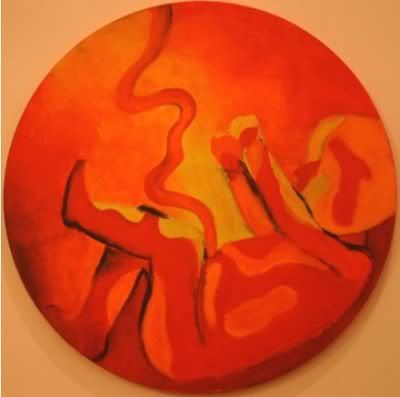
My position would be this, and it is still kind of sketchy, so bear with me: the in-itself of the object-difference, as that level of indifferent-objectality about whose existence we can only speculate, unable to decide one way or another, is precisely the negative mark left on the thing by its own genesis. It is the 'navel' of the thing (and we can take this in Freud's sense of the 'navel' of a dream-work). If I may refer to my last post, this indifference is precisely that of something that had to necessarily be so that the object-difference could contingently come-into-being, but that in no way necessitated that contingent outcome. And moreover, this mark is that of the lost contingency foreclosed by the necessary anterior condition. The indifferent-object is nothing less than the ancestral inexistence, that which could not have been so that what is could have been. The ancestral meets all the criteria of the indifferent-object: it does not make a difference, does not relate to or affect anything; and we can not decide on whether it it exists or non-exists, it is excluded from this very dyad. (Are my Laurellian leanings showing here?)

To conclude, I think any object-oriented philosophy must take into account the genesis of objects, which in turn refers to the paradoxical status of something that neither exists nor does not exist, but rather, is foreclosed by the ontic realm of actual objects.

Tuesday, February 5, 2008

Saving Spinoza

We all know the cliché according to which Spinoza remains a pre-critical philosopher insofar as, in his assertion of the identity of God and nature, he naively asserts a kind of reductionist materialism. Spinoza's nature is a 'closed mechanism', a blind chain of necessity, and freedom, far from some mystical exemption from this chain, is no more than the assumption of this necessity, et cetera. Thus Žižek claims that for Spinoza, ethics (deontology) is simply reduced to ontology, to this blind necessity free of any obscurantist language of teleological aims, a 'Good' which should be imposed on the way things simply 'are'. Such 'oughts' are no more than fictions that falsely impute to God a will or aim, when God in truth is ignorant of any aim and refers to the blind mechanism of natural causality.

So Spinoza ultimately leads us to a naive scienticism in which we need only learn the way things 'really work', devoid of any ideological mystifications. This 'post-ideological' reign of a pure science, in which we should simply administer the means of a satisfactory life free of any overriding prescriptions or projects, is the paradigm of submission to capitalism; Spinozism thus becomes the perfect capitalist ideology. There is no place for the Cartesian subject, subtracted from the closure of this natural necessity, lacking a proper place and lost, necessitating some perhaps 'fictional' narrative of a moral telos in order to act. Indeed, in this model there is properly no 'subject', but only the free play of natural impulses which, upon assuming their modest place within the natural causal order, can live free of such delusions and the harm they cause.

This reading of Spinoza is exemplified in his discussion of Adam's fall: God does not arbitrarily prohibit Adam from eating from the Tree of Knowledge in a simple exercise of authority, with death as the punishment; God is simply warning Adam of the 'scientific fact' that this fruit would be poisonous to him, that eating it would simply 'cause' him to die... Yet as A. Kiarina Kordela puts it in her remarkable book, $urplus: Spinoza, Lacan, it matters not whether this is an arbitrary prohibition or a mere natural fact, because either way, the notion that Adam should prefer life to death would already entail an aim, that he should live, which imposes on the mere 'facts' a fictional telos. [7-8] The point, then, is that any bare scientific analysis of facts, if it is to have any relevance for us, must already be warped by some fictional (ethical) aim imposed upon them; in short, Adam would've already had to have chosen to live.

Kordela's point, in reading Spinoza 'against himself', is that there is no neutral ontology which can simply see God/nature free of any imputed aims; that we are subjects insofar as we necessitate such a fictional imposition. This is the basic Lacanian point, that any chain of knowledge is incoherent, irrelevant without the stabilizing power of the Master-Signifier, the quilting point which fastens this knowledge to some determinate course of action. This quilting point is a fiction, but a necessary one, without which the world and a 'neutral' ontological analysis thereof would have no consistency for us. Yet can we account for this necessity within Spinoza's thought, or must we resort to 'turning him against himself' so as to draw out the inconsistency of his explicit statements? While I like to think I do not succumb to what she identifies as the 'Neo-Spinozist' tendency to take his words at face value, effacing confrontation with the deadlock intrinsic in his work, I nonetheless think his explicit doctrine is more nuanced than she gives it credit for. To be fair, I have only just begun reading this truly fantastic work, and do not know exactly where she will take her reading; yet, at this early stage, I already find it quite useful in explicating my own reading of Spinoza (to what degree this reading conforms to her's I cannot yet say).

I would contend that, far from the naive position that we can be done with the illusion of ethical aims and modestly resort to a neutral scientific analysis of nature, which must be supplemented with the 'critical' assertion of the necessity of these illusions for us, we can take Spinoza a bit further. The point would then be that, if we were to attempt a truly neutral, 'aimless' dwelling within nature, we would find ourselves unable to act, to do anything. Yet far from a mark of our imperfection, our inability to recognize and fully identify with our proper place in the perfect causal order, and the resulting necessity of supplementing this imperfection with a fiction, what if we radically assert that there is nothing to recognize, that there is no 'natural necessity' to which we would conform if freed from fictive aims?

In other words, insofar as God/nature is the complete chain of causes, a 'closed mechanism', that is, insofar as God is not the constitutive exception to the totality of the world but identified directly with the totality without exception, this totality in its 'infinite perfection' is thereby incomplete, inconsistent. Without the exceptional external view which could explicate 'the next link', that is, the 'natural aim' or 'God's will', there is no way to determine the necessary course of things, inclusive of 'what I should do free of any fictive moral aims'. In other words, the only conclusion of a purely neutral knowledge of nature is that necessity coincides with impossibility, with the impossibility of determining necessity without 'taking a chance', acting without any guarantee... We can thus see how Spinoza is the paradigmatic feminine philosopher in the Lacanian sense: God/nature is 'non-All', that is, there is nothing exempted from it, there is no exempted point of God's will (or, for that matter, a 'free subject' in the vulgar sense), but for that very reason this totality cannot attain closure, it remains incomplete and 'open'. Perfection paradoxically coincides with incompleteness just as the completeness of a fictional aim which gives meaning to arbitrary natural necessity is image of imperfection.

So the 'imperfection' of man is not simply his inability to recognize his place within the perfect order of God/nature; rather, this imperfection is transposed into God/nature itself, such that the shift from imperfection to perfection is no more than a change of perspective on one and the same thing. Whereas we, even in accepting that our aims are ultimately fictional, 'relative', may still continue to posit the divine chain of natural causes as simply epistemologically inaccessible to us, though complete in-itself, Spinoza radically asserts, with his 'third kind of knowledge' (intuition), that we can in fact directly know this perfection; my hermeneutical claim is that this 'intuition' involves no more than transposing this inaccessibility of a complete knowledge of perfection into the very incompleteness of perfection itself. We are thus this incompleteness of the Divine as 'for-itself'. (Furthermore, I would propose against Kordela that Deleuze's reading of Spinoza is not filtered through some vulgar Bergsonian vitalism; rather, if we take his understanding of intuition in Bergson as determined by the Spinozan concept as I read it, we can see that, rather than a 'Bergsonized Spinoza', Deleuze already 'Spinozizes Bergson'; I think his reading of élan vital as not some vulgar Universal Life, but rather a principle of self-difference, is evidence in this direction.)

So, to be precise, if we take Spinoza's God/nature along the same lines as the Lacanian assertion that 'God is unconscious', this does not mean that without the fictions constitutive of consciousness we would find a 'true' necessity, a 'proper place' within nature; rather, God/nature is ultimately no more than the impossibility of discovering such a necessity, the limit internal to every aim that prevents it from coinciding with itself, the very incompleteness of perfection as such. Indeed, Kordela hints at such a reading when she insists that Spinoza's assertion that God has no will, that nature is ultimately 'aimless', is to be read in the same way as Lacan's 'the big Other does not exist':
Lacan...maintains that the Other is inconsistent, that "there is no Other of the Other," that the Other in itself has no will or aim... [H]e adopts the Spinozian conception of history as aimless, and supplements it, according to the Spinozian conception of truth, with a willful and intentional gaze (and, hence, aim), which, however, is "a gaze imagined by me in the field of the Other". [17]
And precisely as subjects, who depend on fictional impositions of aims in order to make sense of the world, we are no more than this gaze already inscribed in God: not God's will, but God's opaqueness to itself, the fact that even God does not know his own will, that precisely as perfect, God cannot explain why necessity itself is necessary. Think, for example, of God's speech at the end of the Book of Job, in which he enumerates his own creations as if he himself is amazed at them, as if they are inexplicable even to their creator.

Thus, if freedom is affirmed necessity, it is precisely the assumption of the 'miraculous', inexplicable character of this necessity, the fact that not even God can explain why this was necessary. Spinoza never really elaborates a theory of the subject because the subject is no more than this splitting internal to the divine perfection of nature, this incompleteness/openness that is perfection, necessity. To return to the example of Adam, it is not simply that Adam, in order to make a decision regarding the fruit, must choose some aim (to live or to die), out of ignorance of what God really wants from him; the point is that God himself does not know what he wants of Adam, and hence must leave the decision up to Adam's ignorant, impulsive hubris. The gaze desperately seeking meaning from God is already inscribed in God himself, and is, far from a mark of imperfection, is precisely his perfection as such.

Of course this is only the preamble to such a reading of Spinoza, and I am here setting myself a task I probably won't even begin until my thesis is finished. And I still have a long ways to go in Kordela's book, among others. In any case, I highly recommend $urplus, which presents in my opinion the most original and exciting reading of Spinoza since Deleuze. Whether or not it supports my position, that Spinoza is already a 'critical' philosopher in the strict sense, has yet to be seen, but I am resolute that this is in fact the case. What this means is that, far from reducing deontology to ontology, fictive 'oughts' to the scientific 'is', any more than maintaining the gap between them, Spinoza more radically transposes the gap into the 'is' itself, so that Ethics is the name of the impossible coincidence of God/nature, of the One, with itself. The ethical subject then must assume this gap as his very being, he must identify with this gap/incompleteness that defines the perfection of God/nature.

Contrary to Žižek, Spinoza does not reduce deontology to ontology, but rather raises ontology to deontology. Thus we at the same time denounce fictive 'oughts', ideological aims imposed on the world, and a pure necessary order of 'is' accessible to science: the is, the Being of God/nature, is said only of the must, the vertiginous decision of the subject absent of any justification through aims (the Lacanian act): it is this tautological assertion of an act without any grounding in symbolic coordinates that would 'make sense of it' which selects what must be, which remakes 'what is' by dissolving the symbolic framework that previously defined it, retaining only that which can endure a new evaluation (ultimately, no more than the New itself in History, in the guise of the failed attempts to break out of the given symbolic order which were rendered meaningless by that very order; the act is thus one of Benjaminian Redemption). The is, the Lacanian Real, is ultimately nothing but this immanent limit of symbolization, this necessary inconsistency of every symbolic order, and hence the potential for the New to escape its confines.