Between Levi Bryant's fascinating posts on what he call's "The Ontic Principle", and Graham Harman's new blog "Object-Oriented Philosophy", I've found myself mulling over some objections. Now, I'm not yet familiar enough with either Harman or Latour, so perhaps these objections have already been anticipated, and if anyone can point me toward the relevant literature I'd appreciate it. But it strikes me that 'object-oriented philosophy' is missing something crucial. I touched upon this a bit in my last post, but there I was more concerned with sketching my own concepts, whereas here I'm a bit more critical.
First of all, while I have some sympathy for the urge to simply forget about correlationsim and pounce on the things themselves, I worry that this may be hasty and somewhat reckless. We can raise here a whole set of problems. Firstly, can we simply forget about Kant, who so famously demonstrated our consignment to the phenomenal world of access, and exlcusion from the in-itself? Secondly, who is to say that 'object' is an appropriate way of speaking about the in-itself? Are not objects the specific way things show up for us? If we subtract ourselves from the equation, what reason do we have to believe that objects will remain as objects?
Again, I'm not familiar enough with Harman to know how he would respond, but I am a bit confused by Levi's willingness to embrace objects as the form of the in-itself. This confusion stems from the high regard I have for his fantastic book on Deleuze, which, among other things, critiques any approach to the given that takes it as it is, rather than accounting for the genesis of that given. It seems to me that, from this position, we should arrive not at an object oriented philosophy any more than a subject oriented philosophy, but rather, at a genesis oriented philosophy, aiming to account for the givenness of the in-itself as objectal and accessible or inaccessible.
Now, Levi does lean in this direction with his explicit formulations, but I don't think he's yet made it altogther clear where he stands. For example, his ontic principle claims that "there is no difference that does not make a difference". He explicates this in conversation with Harman by saying that the object is the difference it produces in relation with objects, and moreover, that this differenciation is inexhaustible, the very inexhaustable being of the object in-itself. The object is nothing more than its potential to produce difference, its virtual power to differenciate. Harman, however, responds by claiming that there would still be something of the object even if it produced no difference, even if it was entirely without relation.
It is still unclear whether Levi thinks there is no object apart from its relations, that it is retroactively produced by its differenciation, or whether there is some substantial being of difference behind it; he has said of the virtual that it is nothing but relations amongst actualities, so the latter option seems unlikely. The option I assume he'd vie for, given his definition of the object as act-uality, is that the object is the difference produced in the wake of an event (in Deleuze's sense), and that this event is the only 'substantial' thing there (although substantial is the wrong term).
This ambiguity is clear in the very formulation of the ontic principle: there is no difference that does not make a difference. This is a negative existential statement, making a definite claim about what does not exist. So, what does exist would have to meet the following criteria: if it is a difference, it would have to make a difference. How do we read this? On the one hand, it could mean that a difference always produces another difference, and difference itself minimally occurs between two differences (this is not to be read as external or empirical difference, but the between of a mutual production, as the space between two connected singularities). On the other hand, it could mean that a difference, as a difference, produces itself as a difference. To be clear, this would mean that something different, by virtue of being different, produces the very difference that defines it as a being. In other words, the object-difference produces itself not only as a specific difference in relations with other objects, but, qua difference, as an existing object.
Both readings seem close to Levi's explication, but both have problems. With the first, we have the problem of an ulterior condition: if an object-difference, i.e. an existing being, by virtue of existing, produces other differences, which, again, by virtue of existing, produce other differences, we seem to be dangerously close to lapsing into the kind of transitive causality that Levi's Spinozism should avoid. If we are to avoid it, we must refer to an ulterior condition or immanent causality by which a difference produces itself as difference. Yet this would mean that, in producing itself, the ulterior condition is one of identity, in which the difference makes a non-difference, produces what already is - itself qua object-difference. Now I think these problems can be countered by reference to Deleuze's model of repetition and identity qua product, but this leads us to the second problem.
The second reading seems to refer to such an ulterior condition in which a difference is its own immanent cause, producing itself as an identity, as an identifiable object(-difference). Yet here we have the problem of treating a difference as object - the object-difference must preexist itself in some fashion, it must produce itself, which means it must exist before it exists. On the one hand, the difference must already be there to produce itself as object-difference. On the other hand, the object-difference must retroactively posit itself as its own cause, there at its own birth, so to speak. This temporal paradox will lead us back to a kind of transitive causation, unless we can provide a non-chronological account of production, an immanent production that occurs in being. Here, again, I think Deleuze can help answer these problems with his account of static genesis, and Levi surely knows this if anyone does.
Yet there is a third reading of the ontic principle that could undermine the apparent consistency of the Deleuzian approach, and I believe it is a reading that would fit Harman's own variant of object-orientation. If there does not exist a difference that does not make a difference, that nonetheless means that there could exist a non-difference that does not make a difference. Levi's ontic principle says nothing about the non-existence of non-differences (and here I suspend the strict identification of non-difference and identity). If Levi is attempting to provide a robust, and parsimonius, theory of object-differences, he nonetheless opens the gateway for a different kind of ontic being, an indifferent-object, and object that does not have any impact on other objects, about which we can say that 'it makes no difference whether or not it exists'. For Harman, I think, objects possess a kind of subterranean indifferent-objectality, a being to which other beings are indifferent, regardless of what kind of difference they may or may not make as object-differences.
If an indifferent-object does exist, we apparently have no way of knowing it - or, to generalize this statement for non-subject objects, objects are generally indifferent to the existence of indifferent-objects, which have no impact upon them. So we can really say nothing about indifferent-objects, except that we cannot say whether or not they exist. As far as I know, from the little I've gleaned thus far, Harman does want to claim not only that indifferent-objects exist, but that they are substantial and qualitatively unique. Levi, on the other hand, despite the ambiguity of his formulation, seems quite antithetical to the idea of indifferent-objects. I don't yet know how Harman justifies these claims, if they do accurately capture his position; but I also don't really know how Levi justifies his opposition, and I'm unclear as to how Deleuze's metaphysics leads to the conclusion of the non-existence of indifferent-objects. At best, it seems to me that both Levi and Deleuze would have to leave the question open and unanswerable, perhaps a poorly-stated problem. If so, maybe the ontic principle is itself poorly stated.
In any case, I have a theory regarding all this. Let's take it step by step. In my (potentially straw-man) description of Harman, we have a twofold structure of the object: there is the object-difference, as the difference produced between an object and other objects; and there is the indifferent-object, its subterranean, non-relational inner-being, the in-itself of the object. While this inner-being is indifferent from the perspective of other objects, it is nonetheless a substantial and fully existing sub-stratum.
In an explicitly structuralist variation of Levi's position, the object is nothing but the first level, the object-difference, and in-itself is the pure void of its place of inscription. The object does not exist apart from its differential relations with other objects, but we can nonetheless subtract the totality of these differences, and leave ourselves with a void place. This is also a somewhat Hegelian position, in that 'there is nothing behind the veil but what we put there'.
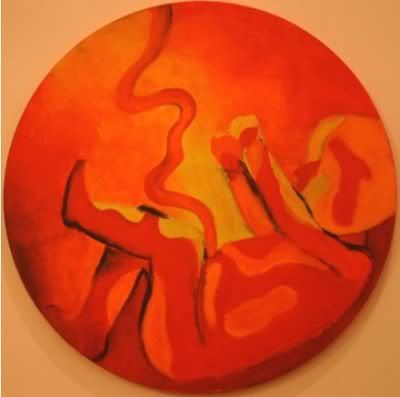
My position would be this, and it is still kind of sketchy, so bear with me: the in-itself of the object-difference, as that level of indifferent-objectality about whose existence we can only speculate, unable to decide one way or another, is precisely the negative mark left on the thing by its own genesis. It is the 'navel' of the thing (and we can take this in Freud's sense of the 'navel' of a dream-work). If I may refer to my last post, this indifference is precisely that of something that had to necessarily be so that the object-difference could contingently come-into-being, but that in no way necessitated that contingent outcome. And moreover, this mark is that of the lost contingency foreclosed by the necessary anterior condition. The indifferent-object is nothing less than the ancestral inexistence, that which could not have been so that what is could have been. The ancestral meets all the criteria of the indifferent-object: it does not make a difference, does not relate to or affect anything; and we can not decide on whether it it exists or non-exists, it is excluded from this very dyad. (Are my Laurellian leanings showing here?)
To conclude, I think any object-oriented philosophy must take into account the genesis of objects, which in turn refers to the paradoxical status of something that neither exists nor does not exist, but rather, is foreclosed by the ontic realm of actual objects.



 Posts
Posts


